Arturia's powerful keyboard sequencer and controller, now redesigned
KeyStep Pro Chroma combines new aesthetic elements, including a sleek dark gray exterior, striking blue LEDs, and other expressive features that allow users to customize their track colors.
These new features add to the already impressive feature list of the 2019 KeyStep Pro, the polyphonic controller that remains a benchmark for creative sequencing with both hardware and software instruments.
With the release of the Arturia KeyStep Pro Chroma, a new and important firmware update (2.5) arrives, offering new and useful features and long-awaited improvements, free of charge for current KeyStep Pro users.
The update is now available for download through MIDI Control Center and arturia
-Meet the Arturia KeyStep Pro Chroma
The keyboard controller that changed the sequencing game, updated with a futuristic exterior and packed with unique creative functionality.
-Sleek dark exterior
An attractive dark gray color gives the KeyStep Pro an industrial and cutting-edge look.
-Vibrant blue LEDs
In perfect contrast with the dark casing, the bright blue LEDs illuminate the setup.
-New and sleek knobs
New and sleek knobs that complement the new design of the KeyStep Pro Chroma.
-Customizable track colors
Exclusive to the KeyStep Pro Chroma, users can now choose from a range of colors for their tracks.
MICROFUSA / BARCELONA STORE
Sepúlveda 134 / Barcelona / Tel.: 930 186 876
MICROFUSA / MADRID STORE
Ardemans 9 / Madrid / Tel.: 910 88 93 30
The MiniFreak has always had a lot to say: two digital engines, analog filters, and a sequencer that invites you to get lost. Its 37-key keyboard, however, fell short for those who wanted to play chords with the left hand while modulating with the right.
The Arturia MiniFreak 49 answers that. It keeps the sound engine of the Freak family and brings it to a 49-key semi-weighted format, with physical wheels and a new XYZ touch surface. It's the same idea, but designed for playing.
What changes in the MiniFreak 49?
Three things, all related to performance.
The keyboard. 49 full-size, semi-weighted keys, with velocity sensitivity and monophonic aftertouch. That means room for chords, melodies, and two-handed passages, and the ability to add expression with finger pressure.
The wheels. Pitch bend and modulation become aluminum wheels, positioned to be at hand while you play.
The XYZ touch matrix. It is the most striking novelty. Control several parameters at once with horizontal and vertical movement and pressure. According to Arturia, it also allows you to assign modulations directly, explore presets with gestures, graphically see how the sound behaves, and draw your own waveforms for the LFOs. The Freak Control feature adds Macro, Gate, and Spice controls, as well as bipolar and vector configurations.
None of these novelties is essential to make a synthesizer sound. Yes, they change how you interact with it: fewer menus and more gestures.
What remains from the MiniFreak?
The sound heart remains hybrid:
6 voices of polyphony, each with its own variable state analog filter and VCA.
Two digital engines with over 30 oscillator modes: virtual analog, FM, wavetable, granular, sample-based, and physical modeling, with algorithms from Arturia, Mutable Instruments, and Noise Engineering.
The second engine can process the signal of the first, which opens the door to complex textures.
Filter FM to modulate filters at audio frequency and Voice Panning to distribute the voices across the stereo field.
Three effect slots with 13 algorithms each, including Self Vocoder and Ext In Vocoder.
256 MB for samples and wavetables.
In addition, the MiniFreak 49 is compatible with the presets of the original MiniFreak. If you already have your own sounds, you can take them from one model to another.
Sequencer and arpeggiator to create without a computer
It includes a 64-step sequencer with four modulation automation lines. The arpeggiator adds octave jumps, ratchets, repetitions, and the Spice & Dice controls, which introduce rhythmic and melodic variations on the fly.
In practice, you can build an idea, let it run, and transform it live with the XYZ matrix. All this happens without opening the laptop.
Integration with your studio
The MiniFreak 49 includes MiniFreak V, the software version of the synthesizer. Communication is bidirectional: you manage presets, edit sounds, and continue working on the project from your DAW.
For connections, it has MIDI In, Out, and Thru, USB-C, audio input, Clock In/Out, sustain pedal input, and stereo outputs. Arturia indicates compatibility with polyphonic aftertouch when used with controllers that support it.
It comes with 350 factory presets, identified by colors in the matrix, and 162 user positions.
Who is the MiniFreak 49 for?
It fits if:
You are looking for a hybrid synthesizer to play, not just to program.
You feel limited with a 37-key keyboard or want to play with two hands.
You perform live and want to modulate without diving into menus.
You are interested in sound design with many types of synthesis in a single machine.
It might not be for you if:
You need a compact instrument for travel or a desk with little space. In that case, the 37-key MiniFreak
You already have a MiniFreak and use it mostly in the studio controlled from the DAW: the difference is more in performance than in the sound engine.
You are looking for more than 6 voices of polyphony.
Frequently asked questions
Can I use my presets from the original MiniFreak?Yes. Arturia confirms compatibility with the presets of the original MiniFreak.
Does it have polyphonic aftertouch?The keyboard has monophonic aftertouch. Arturia mentions compatibility with polyphonic aftertouch when used with controllers that support it.
Do I need a computer to use it?No. The sequencer and arpeggiator work autonomously. MiniFreak V is optional and is used to edit and manage sounds from the DAW.
What software does it include?MiniFreak V, the software version of the synthesizer.
Choose wisely
The MiniFreak 49 does not change the essence of the MiniFreak: it puts it in a format where it can be played. If you are torn between this version and the 37-key one, tell us how you work and we will help you decide.
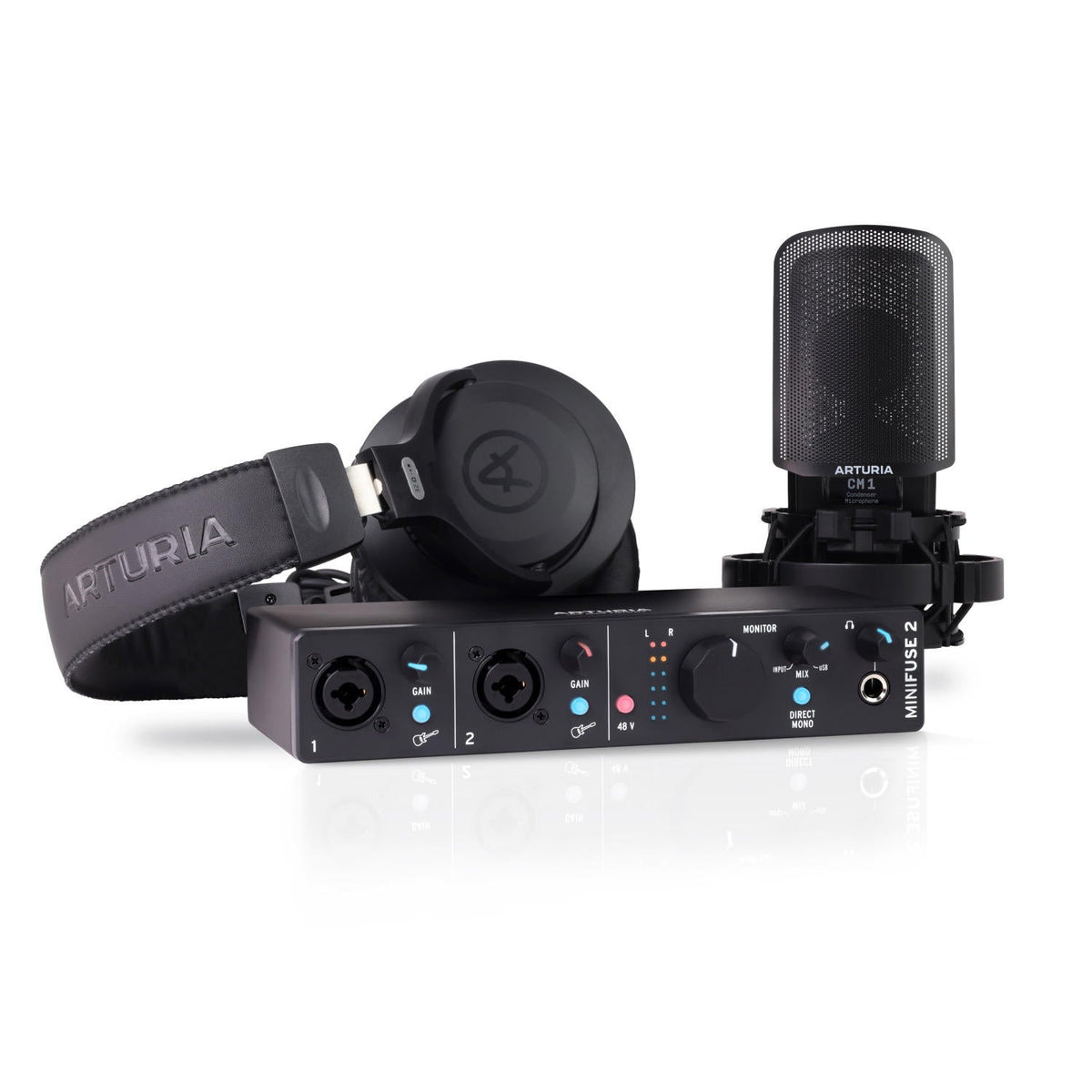
A selection of audio interfaces from Universal Audio, Arturia, RME, Audient, Focusrite, and Solid State Logic, highlighting their key features and options for studio work, production, and content creation.
🎹 Arturia KeyStep mk2: the ultimate evolution of the compact controller
The Arturia KeyStep mk2 arrives at Microfusa to take your creativity to the next level. The natural evolution of the acclaimed original KeyStep combines the reliability and simplicity that made it a classic with the creative depth and expanded connectivity that make it essential in any modern setup.
Whether you work with modular synthesizers, vintage hardware, or your favorite DAW, the KeyStep mk2 offers you a smooth, powerful, and musical experience from the very first touch.
🚀 Take the step towards your next idea
The original KeyStep earned its place in studios and stages around the world thanks to its intuitive design and its ability to connect modular instruments, controllers, and software without complications.
With KeyStep mk2, Arturia takes a leap forward by incorporating generative and mutant tools, a bright OLED display, and a redesigned sequencer that transforms the way you create and control your sounds.
And as always, at Microfusa you can try it, discover its possibilities, and find the advice you need to integrate it into your studio or live set.
✨ New features of the KeyStep mk2
🎛️ Total connectivity
Thanks to its extensive connectivity —USB-C, DIN MIDI I/O, CV/Gate outputs, Sync I/O, and pedal input— the KeyStep mk2 can easily be integrated into any environment: from a professional studio to a modular system or a live performance.
It also includes an additional CV output (Mod 2) and a practical power switch, making it the ideal control center for your equipment.
💡 Improved sequencer
The new polyphonic sequencer offers 8 additional memories, non-quantized recording, Bend & Mod automation, Undo function, step editing, and pattern chaining.All this allows you to build more complex and dynamic phrases without losing creative flow.
🎵 Smart arpeggiator
The redesigned arpeggiator of the KeyStep mk2 includes features such as Arp Reset to turn arpeggios into phrases, and the new “Arp Pattern” mode, which generates unique melodies, basslines, and chords from the notes you play.
🌀 Creativity in motion
The new Mutate, Spice/Dice, and real-time transformations features add a generative and spontaneous touch to every performance, helping you break out of the predictable and explore new ideas with just a turn of a knob.
⚙️ Hardware-based control
The OLED display and the push encoder make control easier without relying on the MIDI Control Center software. Everything essential is at your fingertips, in a compact and robust design ideal for the modern musician.
🔊 Conclusion: a new creative standard
The Arturia KeyStep mk2 is not just an update: it is a tool designed to inspire, connect, and evolve with your music.If the original KeyStep was a modern classic, this new version redefines what a professional compact controller can do.
Find it now at Microfusa, available both in-store and online, with fast shipping and advice from our specialized team.
🎹 Discover the new Arturia KeyStep mk2 at Microfusa and take the step towards your next idea.👉 View product at Microfusa
Subscribe to our newsletter
We will keep you informed about all promotions and news


 With the release of the Arturia KeyStep Pro Chroma, a new and important firmware update (2.5) arrives, offering new and useful features and long-awaited improvements, free of charge for current KeyStep Pro users.
The update is now available for download through MIDI Control Center and arturia