

Updated in October 2026. Selection guide based on manufacturer specifications, not on a comparative listening test.
Enter the next track. Instead of pushing a fader, you turn a knob and decide how much space to give it in the mix. The gesture changes. Your musical judgment remains the same.
Rotary DJ mixers are not a password to enter a club of connoisseurs. They are another way to control levels, work transitions, and relate to the music. And not all offer the same.
In this update, we compare six models from the microFusa catalog: AlphaTheta euphonia, Ecler WARM2 and WARM4, Headliner R2 and R4, and Omnitronic TRM-402. The question is not which one has more prestige. It is which one fits what you want to do.
What is a rotary DJ mixer?
It is a mixer where the channel level is controlled with rotary knobs instead of the usual linear faders. That change affects the gesture and the movement with which you introduce or remove a track.
It can be convenient for gradually adjusting the balance between two tracks or keeping several layers playing. But the smoothness of a transition also depends on the control curve, the gain adjustment, and your hands. A round knob does not mix for you.
It also does not automatically mean that the mixer is completely analog, that it sounds better, or that it lasts longer. The euphonia, for example, combines digital processing and an analog circuit with a transformer. It is worth looking at the specific design, not just the aesthetics.
What changes compared to a mixer with faders?
If your way of DJing relies on progressive intros and long mixes, rotary control may suit you. If you need quick cuts, scratching, or techniques centered on the crossfader, the format of these mixers probably won't be your starting point.
There are no genres with admission rights. House, disco, techno, soul, or a selection that doesn't fit into a label: what matters is how you mix, not what the folder is called.
And a distinction that prevents wrong purchases: EQ per channel, master isolator, and filter are not the same. The EQ works on a source; the master isolator acts on the overall mix; a high-pass or low-pass filter modifies the spectrum starting from a cutoff frequency. Before choosing, think about which of those gestures you want to have available.
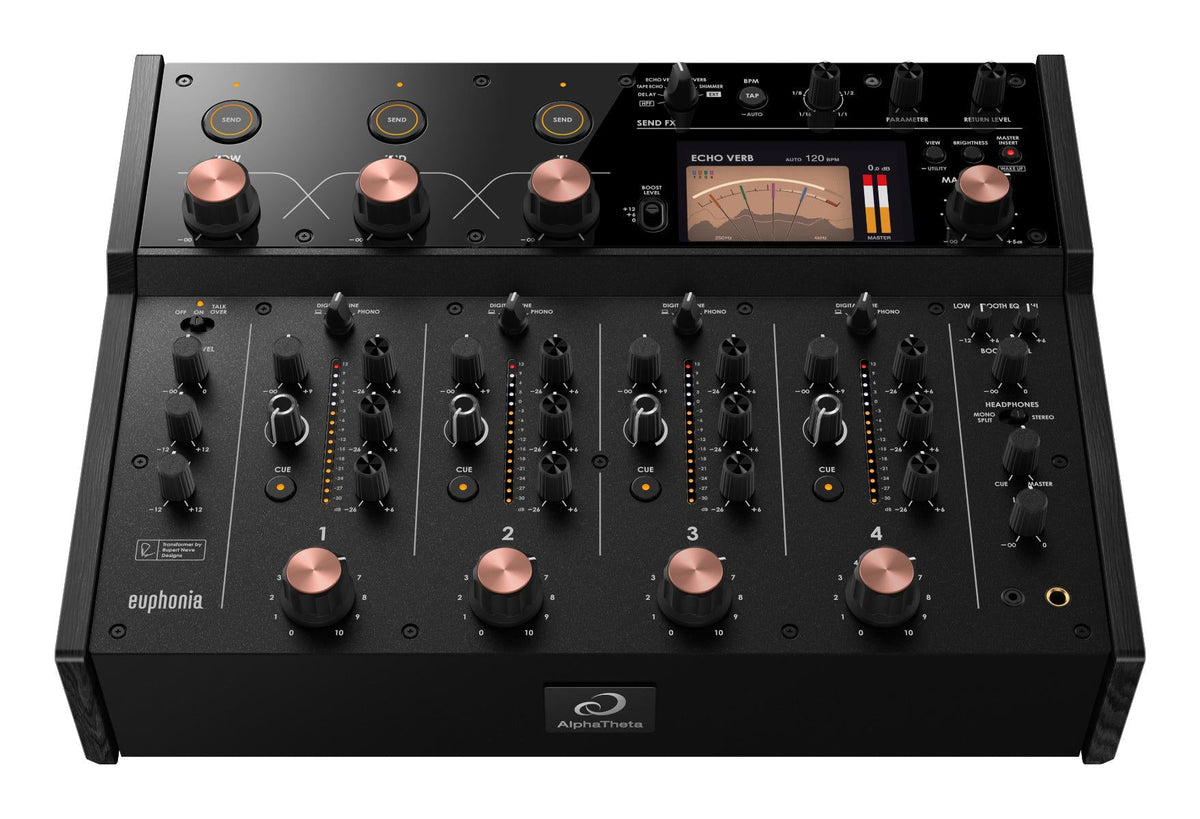
What does the AlphaTheta euphonia offer?

If you are looking for "the Pioneer rotary," the model to look for is the AlphaTheta euphonia: that is the brand with which it is marketed.
It features four channels, digital processing, and a transformer circuit co-designed with Rupert Neve Designs. It integrates a three-band master isolator, five spatial effects, and a high-pass filter in its Send FX section.
Its Boost Send function allows you to apply an effect to one band of the isolator. The idea is not just to mix levels: it also invites you to use the frequencies and sends as part of the performance.
Who it makes sense for: anyone who wants four channels and integrated effects within a rotary workflow, without always relying on external units.
Its limit: if your goal is a completely analog mixing chain, this hybrid architecture does not meet that requirement. You also don't need all its possibilities if you only want to mix two sources with simple controls.
View AlphaTheta euphonia at microFusa
Ecler WARM2 or WARM4?
WARM2: two main sources and the isolator at hand

The WARM2 is an analog mixer designed and manufactured in Barcelona. Its configuration is two phono/line main channels plus one micro/line channel. The mains have three-band EQ with full cut, and the mixer incorporates a fourth-order three-band isolator and effect send control with pre/post selection.
We would choose it for anyone who habitually works with two turntables or two players and wants to explore volume, EQ, and the isolator without setting up a four-channel surface.
Its limit: the additional micro/line channel does not turn the WARM2 into a three-main-channel mixer equivalent. If you want to expand your session to more sources with the same control, it is worth looking at the WARM4.
WARM4: four channels and a specific tool for sub-bass

The WARM4 expands the concept to four phono/line channels, with three-band EQ, master isolator, and effect sends with per-channel pre/post selection.
Its distinguishing feature is the per-channel selectable analog subharmonic synthesizer, designed to generate and reinforce sub-bass frequencies.
We would choose it to combine more sources within an analog architecture and work with external effects.
Its limit: generating more sub-bass does not automatically improve a track. It is a tool that must be adjusted by listening to the track and the response of the sound system, not a button that should always be left activated.
What do the Headliner R2 and R4 offer?
Headliner R2: two channels and a filter to intervene in the mix

The R2 combines two stereo channels with phono/line inputs, per-channel three-band isolator EQ, and an analog filter with high-pass and low-pass modes, frequency, and resonance. Each channel has a selector to assign it to the shared filter.
We would choose it if you want a two-channel mixer and are especially interested in building transitions with filter sweeps.
Its limit: its per-channel isolator EQ should not be confused with an independent three-band master isolator. They are different ways of working.
View Headliner R2 at microFusa
Headliner R4: more sources, maintaining the filter's prominence

The R4 takes that approach to four stereo channels, with per-channel three-band isolator EQ and analog high-pass/low-pass filter with frequency and resonance controls.
We would choose it to mix more sources without giving up that direct way of working the filter.
The detail you should check: it offers four line inputs, but only three phono. Four channels do not mean you can connect four turntables directly to four integrated phono preamps.
View Headliner R4 at microFusa
Where does the Omnitronic TRM-402 fit?

The TRM-402 brings together four channels with phono/line selection, two-band EQ per channel, and a three-band master isolator. It uses ALPS Blue Velvet RK27 potentiometers.
We would choose it if you are looking for four rotary channels and want to give prominence to the overall mix isolator.
Its limit: the per-channel EQ has bass and treble, without an independent mid control. If you usually work that area a lot on each track, it is an important difference compared to the models with three-band EQ. Its master isolator should not be confused with per-channel high-pass and low-pass filters.
View Omnitronic TRM-402 at microFusa
Which would we choose according to your way of DJing?
If you work with two sources and want a master isolator, we would start by looking at the Ecler WARM2. If you prefer to give prominence to the high-pass/low-pass filter, we would compare the Headliner R2.
For four sources, we would distinguish three needs: WARM4 for analog architecture with sends and subharmonic synthesis; R4 for per-channel EQ and shared filter; TRM-402 for a two-band per-channel EQ and global isolator setup.
And if you are looking for four channels with integrated effects and a hybrid architecture, the AlphaTheta euphonia deserves to be in the comparison.
We would not choose based only on the number of knobs, the finish of the sides, or the promise of a "more authentic" sound. We would choose based on the connections and the gestures you are really going to use.
What is worth trying before deciding?
Make a transition with two tracks you know. Check how much the level changes when turning the knob, if you can comfortably hold a long mix, and how the EQ responds when the two tracks share bass.
Then think about your complete setup: turntables, players, recording, monitors, and possible external effects. If you use a computer or DVS, confirm the interface, routing, and compatibility you need for the chosen model. The rotary format, by itself, does not guarantee any of that.
At microFusa, tell us what you connect and how you DJ. We will help you compare options and check the possibility of trying them in Barcelona or Madrid.
The best rotary mixer is not the one that makes you look like another DJ. It is the one that lets you mix your way.
Frequently Asked Questions
Does a rotary mixer sound better than one with faders?
Not necessarily. The type of volume control does not determine the sound quality by itself. You have to assess the circuit, the connections, the levels, and the listening system.
Are all rotary mixers analog?
No. The AlphaTheta euphonia combines digital processing and an analog circuit with a transformer. Rotary describes the way of controlling the level, not the entire audio architecture.
Are the isolator and filter the same?
They are not equivalent controls. A three-band isolator allows you to act on bass, mids, and treble; a high-pass or low-pass filter works starting from a cutoff frequency. In addition, it matters if the control acts on a channel or on the complete mix.
Do I need four channels to start with a rotary mixer?
No. Two main channels may be enough if you mix two sources. Choose four when your setup and your way of DJing need that margin, not just for foresight.


