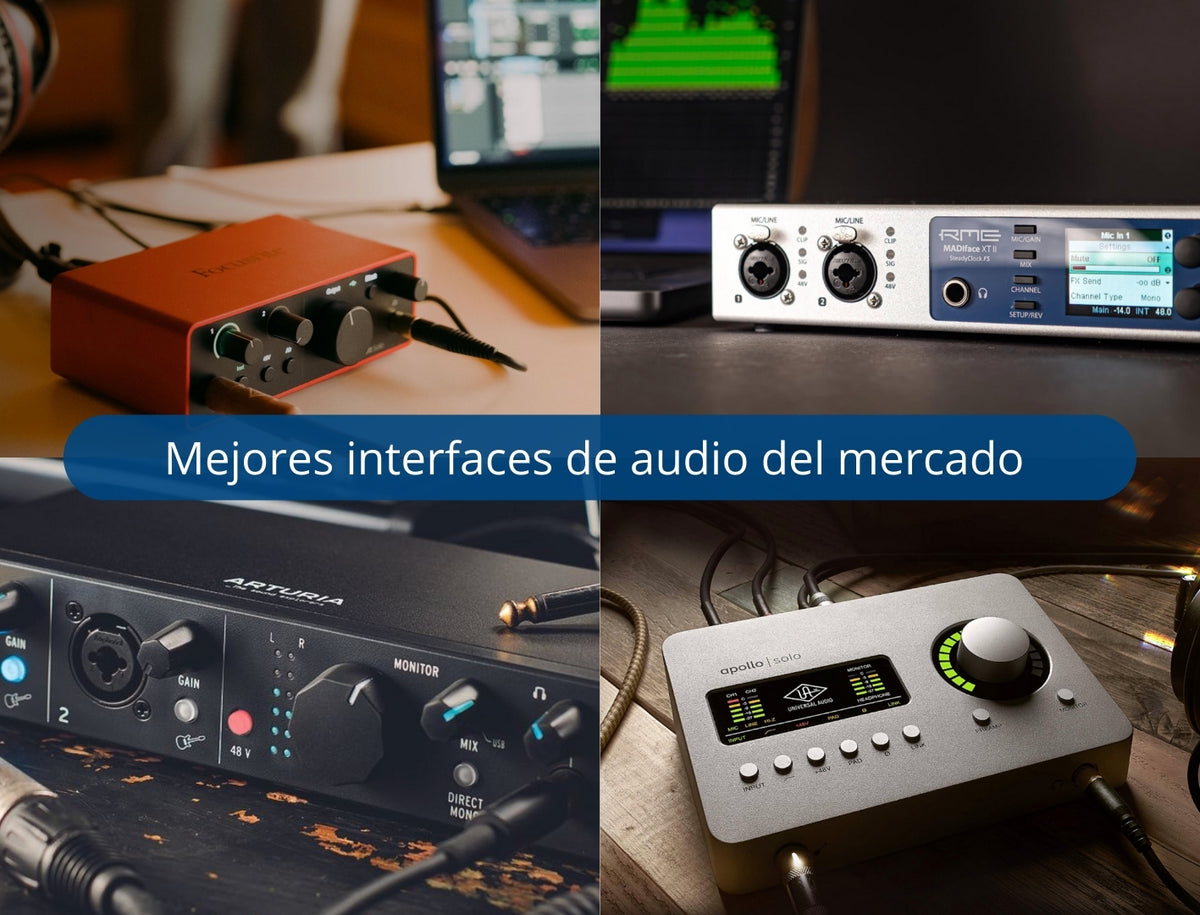
Choosing a suitable audio interface is one of the most important decisions for any music producer, DJ, content creator, or sound engineer. Conversion quality, driver stability, and preamps make a real difference both in the studio and live.
In this article, we present a selection of the best audio interfaces on the market, with options for different recording, production, and content creation needs. The choice will depend on the inputs and outputs you need, compatibility with your computer, and your way of working.
1. Universal Audio – Apollo and Volt

Universal Audio offers two families with different approaches: Apollo, with UAD DSP processing, and Volt, with USB options for recording and production.
🔹 Apollo (Twin, x4, x6, etc.)
- AD/DA conversion for recording and monitoring.
- Real-time UAD processing, with compatible plugins running on the interface's DSP.
- Desktop and rack options depending on the connections your studio needs.
Among the catalog options is the Apollo Twin X DUO Gen 2, with two Unison preamps. This model uses Thunderbolt 3: check the computer and cable requirements, because a USB-C port does not guarantee Thunderbolt compatibility. The plugin package depends on the edition purchased.
🔹 Volt
- USB interfaces with different input and output configurations.
- Vintage Mic Pre mode on models like the Volt 276.
- Analog compressor on models like the Volt 276 and the Volt 476.
The Volt 2 Gen 2 and the Volt 2 Max are also in the catalog. It is advisable to compare the features of the specific model, without transferring the characteristics from one generation to another.
To keep in mind: Volt does not include the Apollo UAD DSP. On the Volt 276, the analog compression applied at the input is recorded in the signal.
👉 Two paths within Universal Audio: Apollo for those who need their workflow with UAD DSP, and Volt for a USB setup with direct recording controls.
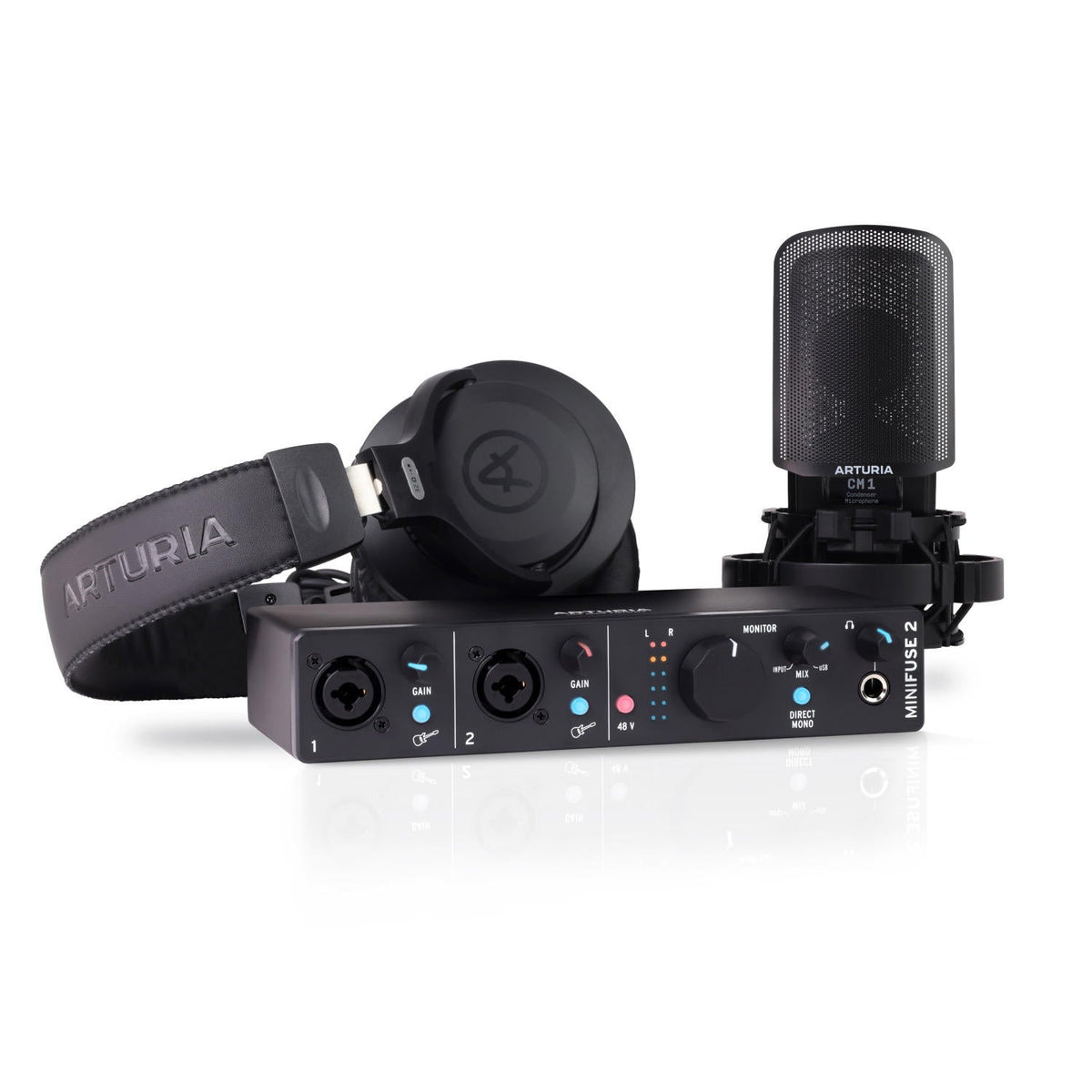
2. Arturia MiniFuse 2

The MiniFuse 2 stands out for its compact design, its connections, and its ease of integration into a production desk.
- Two combo inputs to record two sources simultaneously.
- Integrated USB hub and five-pin MIDI connections.
- Loopback to capture audio from the computer.
- Included software package, subject to the terms of the licenses.
- White, Black and Champagne finishes in the catalog.
As an alternative for working with two devices, the MiniFuse 2 OTG allows exchanging audio between computer and mobile or tablet via its USB connections. Its OTG port does not power the interface: the power supply must be resolved via the Computer connection and check the mobile device requirements.
👉 Compact and versatile for recording, production, and content creation. The USB hub does not add audio inputs and its power supply capacity is limited.
3. RME – Babyface and Fireface

RME is an option to consider when drivers, routing, and monitoring play an important role in your work. The final latency also depends on the computer, buffer settings, and the session.
🔹 Babyface Pro FS
- Compact format for studio and mobile work.
- Two microphone preamps and two additional line or instrument analog inputs.
- ADAT/S/PDIF optical connections and MIDI.
- Mixing and monitoring routing with TotalMix FX.
🔹 Fireface (UCX, UFX, and 802)
- Advanced routing with TotalMix FX.
- Different analog and digital connection configurations.
- Options for studios and setups that need more channels.
RME models in the catalog:
- RME Fireface UCX II
- RME Fireface UFX II
- RME Fireface UFX III
- RME Fireface 802 FS
- RME Fireface 802 FS ES
👉 Interesting if you need to organize different monitoring mixes. TotalMix requires getting familiar with its structure; compare the connections of the specific model before choosing.
4. Audient – iD14, iD22, and EVO

Audient brings the preamp design from its analog consoles to the iD series, while EVO offers a handling focused on recording agility.
🔹 iD Series
- Microphone preamps based on the Audient console design.
- Options for recording voices and instruments.
- Different monitoring and expansion possibilities depending on the model.
To expand the comparison, the iD24, the iD44 MKII and the iD48 are also in the catalog. They are not equivalent in the number of preamps, connections, or format.
The iD14 MKII, for example, allows adding inputs via ADAT, but requires compatible external equipment. The iD4 MKII does not offer that same expansion path.
🔹 EVO Series
- Smartgain to help automatically adjust the initial gain.
- Loopback to integrate audio from applications.
- Setups for home studios, podcasting, and content creation.
👉 iD if you are looking for its recording, monitoring, and connection possibilities; EVO if you are interested in a workflow with assisted level adjustment. Smartgain helps prepare the take, but it does not replace listening during recording.
5. Focusrite Scarlett – 3rd and 4th Gen

The Scarlett series brings together interfaces for different recording scales, from single voice and instrument setups to studios that need multiple inputs and outputs.
Key features:
- Microphone, line, or instrument inputs depending on the model.
- Air mode and monitoring functions.
- Different configurations for music production, podcasting, and home studio.
- On models like the 2i2 4th Gen, Auto Gain and Clip Safe help adjust the levels.
The features are not identical between generations or between models of the same generation. For example, it is not advisable to attribute Auto Gain and Clip Safe to the entire Solo range. Before buying, confirm the driver compatibility with your operating system and recording program.
Focusrite Scarlett models in the catalog:
- Focusrite Scarlett Solo 4th Gen
- Focusrite Scarlett 2i2 4th Gen
- Focusrite Scarlett 4i4 4th Gen
- Focusrite Scarlett 18i20 4th Gen
- Focusrite Scarlett 2i2 Studio 4th Gen
- Focusrite Scarlett Solo Studio 4th Gen
Models like the Scarlett 2i2 or 4i4 are options for home studios, podcasting, and music production. On the 2i2, the front and rear connectors do not add four simultaneous analog inputs: it allows recording two at a time.
ADAT Expansion: Scarlett OctoPre
The Scarlett OctoPre and the Scarlett OctoPre Dynamic are multichannel preamps with conversion to expand a compatible system. They do not replace a USB interface connected to the computer: you need an interface with the proper digital connection.
👉 A family with different sizes to start or expand your studio. Choose by the inputs and outputs you need, not just by the Scarlett name.
6. Solid State Logic – SSL 2 MKII, SSL 2+ MKII, and SSL 12

Solid State Logic (SSL) brings part of its studio approach to desktop interfaces with direct controls and the Legacy 4K analog circuit, inspired by the SSL 4000 series consoles.
🔹 SSL 2 MKII and SSL 2+ MKII
- Two input channels for microphone, line, or instrument.
- Legacy 4K per channel to add treble enhancement and harmonic content.
- Direct monitoring mix control and stereo loopback.
- USB power and SSL Production Pack software package, subject to its license terms.
The SSL 2 MKII offers two balanced monitor outputs and two headphone connections that share mix and level. The SSL 2+ MKII adds two more balanced outputs, headphones with independent mixes and levels, and MIDI input/output.
To keep in mind: the "+" sign does not add more analog recording channels: both allow recording two. Their difference is in the outputs and the possibilities of collaboration and connection.
🔹 SSL 12
The SSL 12 expands the proposal with four microphone preamps, Legacy 4K per channel, two independent headphone outputs, MIDI, integrated talkback microphone, and monitoring mix management via SSL 360°.
Its ADAT input allows incorporating up to eight additional digital channels via compatible external equipment. The twelve total input channels do not equal twelve integrated microphone preamps, and the expansion capacity depends on the sampling rate.
👉 SSL 2 MKII for a two-source setup; SSL 2+ MKII if you need more outputs, MIDI, and shared monitoring with greater control; SSL 12 to record more microphones and expand the studio via ADAT.
Which is the best audio interface for you?
It depends on your use and the connections you need:
- Production and monitoring with UAD processing: Universal Audio Apollo.
- Advanced routing and monitoring mixes: RME Babyface and Fireface.
- Home studio: Focusrite Scarlett, Audient iD, Universal Audio Volt, or SSL 2 MKII, depending on the model.
- Shared recording and expansion: SSL 2+ MKII for its outputs and monitoring; SSL 12 if you need four preamps and ADAT input.
- Content creators: Arturia MiniFuse or Audient EVO; MiniFuse 2 OTG if you need to exchange audio with another device.
Before deciding, count how many sources you will record at once, how many outputs you need, and what connections your computer supports. No brand is limited to a single type of user.
At microFusa, you will find these options and advice to choose the one that best fits your workflow. Tell us your setup and check the demonstration possibilities in Barcelona or Madrid.
🎧 Discover the audio interfaces and choose the one that fits your studio.