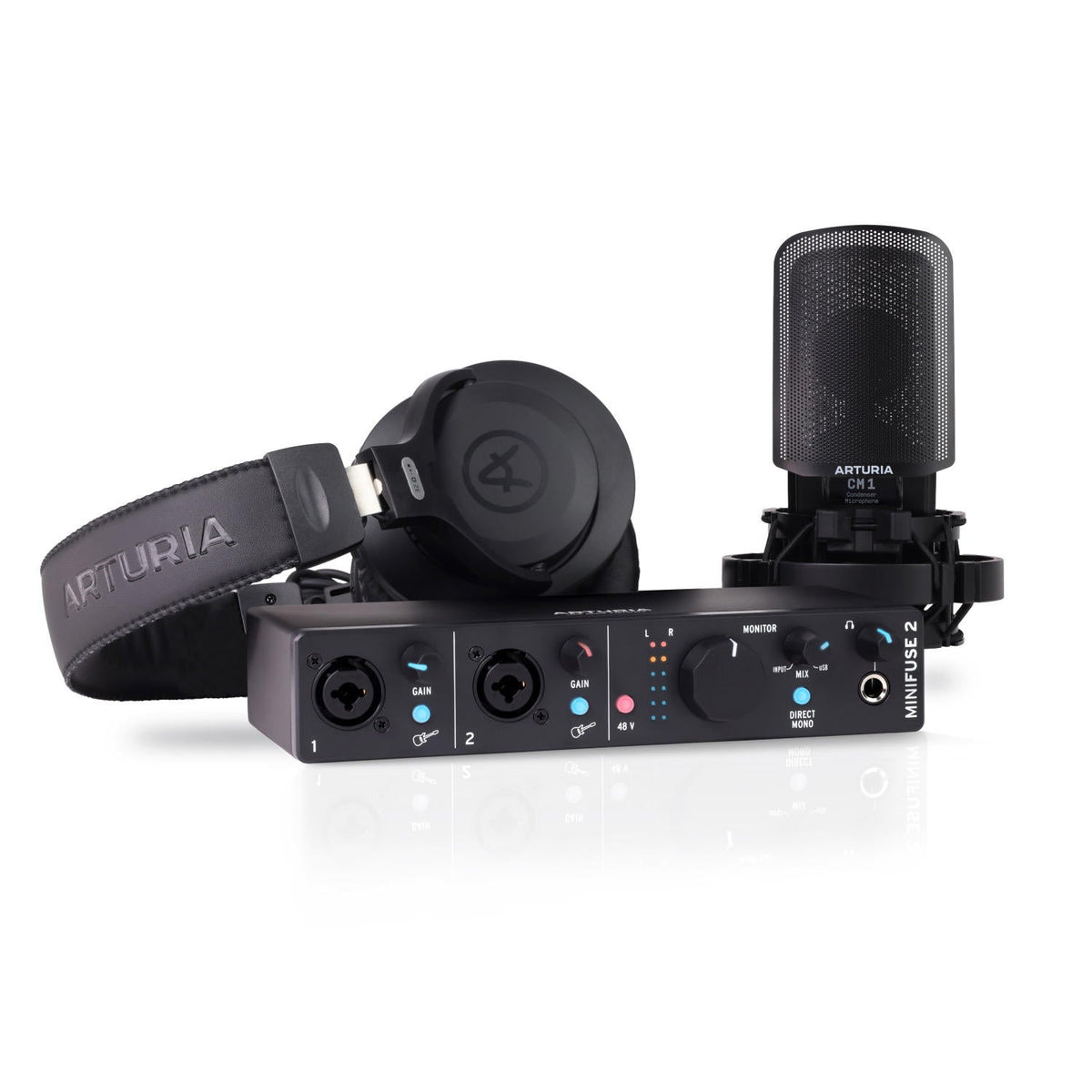
Every artist has specific needs. And if you're looking for an audio interface, you'll want it to have certain features. You might need one input, or you might need six. Perhaps you're going to connect microphones or synthesizers. That's why in today's article we're going to show you the 5 best audio interface series. A selection in which we are sure you will find the audio interface that best suits what you are looking for.
The Arturia AudioFuse Studio audio interface series is, without a doubt, unsurpassed in terms of versatility and features to improve workflow, and includes a wide variety of features in its compact desktop format. AudioFuse Studio offers you all the studio tools you need at a very affordable price. Offering you more clarity when mixing, recording drums using the Glyn Johns technique with 4 pristine, unprecedented preamplifiers, connecting your entire collection of synthesizers, and playing through your studio monitors or headphones without turning on your computer, playing guitars with dedicated instrument-level outputs, or tracking a full band using the ADAT expansion ports.
2 pairs of balanced TRS outputs for speakers, with built-in A/B switching
2 independent stereo headphone outputs, with 6.35 and 3.5 mm jacks
2 independent analog line outputs with amplification capability (instrument-level output)
Direct monitoring from ultra-low latency internal mixers
ADAT i/o allows 8 additional inputs and 8 outputs, up to 96kHz
Excellent connectivity: MIDI i/o, backward compatible USB-C, S/PDIF i/o, Word clock input, output/thru on RCA Cinch
Latest generation 24-bit AD/DA converters with a sampling rate of up to 192 kHz
Self-positioning leather-covered protective cover
Robust metal desktop chassis
AudioFuse Control Center software for routing audio and controlling master settings
AudioFuse Creative Suite included
The Arturia AudioFuse Studio series includes:
TridA Pre: Which offers you that rare Soho preamp sound and that musical EQ that have flavored countless bestsellers for half a century.
1973 Pre: Inspired by the sound of British studios, the Arturia 1973-Pre interface is the key to getting that harmonically exciting 70s solid-state tone.
V76 Pre: The key to getting that “White Album” sound.
Mini Filter: Dr Robert Moog's smooth and iconic stepped filter, accurately recreated and updated with an LFO, envelope follower, and step sequencer.
Comp FET-76: Modeling of the most sought-after compressor in the world, the Class A FET sound of Arturia's 1176 software recreation seems to make anything sound better.
Delay TAPE-201: You will get everything you love about the sound of vintage tape delays, but with the reliability and versatility of software.
At the NAMM Show held last January at the Anaheim Convention Center, Tascam, the professional audio division of TEAC Corporation, presented its two new audio interfaces. Two interfaces that integrate new technologies that allow for higher recording quality and an improved mixing system from DSP. They were the new Series 102i and 208i models, both capable of quality recording up to 192kHz on Windows and Mac (also supports iOS), via USB 2.0 connection.
The two interfaces integrate a new DSP system for both input and output control, with built-in reverb, compressor, phase inversion, four-band equalizer effects, all individual for each channel. But let's see the differences between both models:
The Tascam Series 102i features 2 combo analog inputs with preamps and 48V Phantom power. It can be expanded via an S/MUX optical port to achieve up to 10 inputs, accepting up to 8 channels from a compatible ADAT or S/MUX device. It also features dual headphone output and control, MIDI connectivity, and two balanced line outputs.
The Tascam Series 208i is similar to the 102i although broader in its features. It features 4 combo mic/line inputs with preamps with 48V Phantom power and the possibility of expansion up to 20 inputs in digital format. It features 8 balanced line outputs for monitoring up to 7.1 surround. It also includes dual headphone input and control and master fader.
Audient iD
After the sale of their company DDA (a company widely known for designing mixing consoles during the 1980s and 1990s) and the emergence of digital consoles, David Dearden and Gareth Davies founded Audient in 1997. Their goal was to stay in the analog console market with a high-quality, efficient, and at the same time affordable sound. They achieved it with the ASP8024, a real industry benchmark. But their efforts did not stop there. Audient also stands out for its mic preamps, its monitor controllers, and its audio interfaces. Their high-performance iD series interfaces are synonymous with quality.
The iD4 is an audio interface with 2 inputs and two outputs that offers the audio performance of a large format console in a compact, portable, and ergonomic design. Equipped with a microphone preamplifier from the renowned Audient interface range, first-class conversion technology, dual headphone output, console-type monitor control, a JFET DI instrument input, and ScrollControl virtual displacement technology, the iD4 is a professional and, at the same time, affordable solution for both the home studio and when you are on the go.
The iD14 is an audio interface with 10 inputs and 4 outputs that offers the audio performance of a large format interface in a compact and elegant design. It incorporates a pair of microphone preamplifiers, high-quality Burr Brown converters, console-style monitor control, JFET DI instrument input, and the new and revolutionary ScrollControl feature.
The iD22 is an audio interface with 10 inputs and 4 outputs with a monitoring system. Like the iD14, it incorporates a pair of microphone preamplifiers, high-quality Burr Brown converters, console-style monitor control, and JFET DI instrument input. But it also includes expandability through ADAT, user-defined function keys, balanced insert points, and much more.
The iD44 is an audio interface with 20 inputs and 24 outputs, the most powerful of the series to date. It includes four microphone preamplifiers equal to those of the Audient consoles, first-class converters, expansion capability via ADAT, and much more. The iD44 offers you the same performance as an Audient console but in a size ideal for your desk, which guarantees you the professional sound you deserve.
SSL SSL2
The Solid State Logic brand has been in the music production market for over 40 years, helping world-famous artists, producers, and studios create many of the most legendary albums in history. For the first time in its history, last January it presented its first audio interfaces, a milestone in music production, since with the SSL2 series we can enjoy the incredible quality of its preamplifiers at a very affordable price for a home studio format.
Among the features of these audio interfaces, we can highlight analog microphone preamplifiers with SSL design and flawless conversion at 24/192 kHz for maximum quality recordings, monitoring routes, and high-performance headphone amplifiers for clear playback and intuitive low-latency mixing control on the front panel.
In addition, the “Legacy 4K” mode, inspired by the classic SSL consoles, offers you the possibility of adding additional analog character and brightness to your sources when necessary. Not only that, the SSL Production Pack software package includes some of the SSL Native studio programs and a carefully selected selection of DAWs, Samples, Loops, and virtual instruments from industry leaders.
Next, let's see the features of the two models of the series, the SSL2 and the SSL2+
SSL 2
Class-leading microphone preamplifiers (130.5dB EIN / 62dB gain).
Pro-Studio Neutrik quality connectors and Alps pots.
High-current headphone amplifier.
24-bit / 192 kHz AKM converters.
Enhanced Legacy 4K processing
Inspired by the SL4000 series mixer.
SSL Production Pack
Exclusive software package.
Advanced workflow in ergonomics, layout, and metering.
SSL 2+
Class-leading microphone preamplifiers (130.5dB EIN / 62dB gain).
Pro-Studio Neutrik quality connectors and Alps pots.
2 headphone amplifiers with independent monitoring mix.
24-bit / 192 kHz AKM converters.
Enhanced Legacy 4K processing
Inspired by the SL4000 series mixer.
MIDI I/O.
2 additional unbalanced outputs for DJ mixers.
SSL Production Pack
Exclusive software package.
Advanced workflow in ergonomics, layout, and metering.
Focusrite Scarlett
From its factory in High Wycombe, England, Focusrite designs and markets microphone preamplifiers, consoles, analog equalizers and channel strips, digital audio processing hardware and software, and audio interfaces. Among its interfaces stands out the Scarlett series, the best-selling USB audio interface in the world. An ideal device for producers, composers, singers, and guitarists who want to record their music with studio quality.
With six input and output configurations, with the highest performing microphone preamplifiers you have ever heard, and with high-margin instrument inputs and high-performance converters, the Scarlett series by Focusrite has allowed millions of artists around the world to record, mix, and play back high-quality audio. Let's see the different configurations of the series below:
The MiniFreak has always had a lot to say: two digital engines, analog filters, and a sequencer that invites you to get lost. Its 37-key keyboard, however, fell short for those who wanted to play chords with the left hand while modulating with the right.
The Arturia MiniFreak 49 answers that. It keeps the sound engine of the Freak family and brings it to a 49-key semi-weighted format, with physical wheels and a new XYZ touch surface. It's the same idea, but designed for playing.
What changes in the MiniFreak 49?
Three things, all related to performance.
The keyboard. 49 full-size, semi-weighted keys, with velocity sensitivity and monophonic aftertouch. That means room for chords, melodies, and two-handed passages, and the ability to add expression with finger pressure.
The wheels. Pitch bend and modulation become aluminum wheels, positioned to be at hand while you play.
The XYZ touch matrix. It is the most striking novelty. Control several parameters at once with horizontal and vertical movement and pressure. According to Arturia, it also allows you to assign modulations directly, explore presets with gestures, graphically see how the sound behaves, and draw your own waveforms for the LFOs. The Freak Control feature adds Macro, Gate, and Spice controls, as well as bipolar and vector configurations.
None of these novelties is essential to make a synthesizer sound. Yes, they change how you interact with it: fewer menus and more gestures.
What remains from the MiniFreak?
The sound heart remains hybrid:
6 voices of polyphony, each with its own variable state analog filter and VCA.
Two digital engines with over 30 oscillator modes: virtual analog, FM, wavetable, granular, sample-based, and physical modeling, with algorithms from Arturia, Mutable Instruments, and Noise Engineering.
The second engine can process the signal of the first, which opens the door to complex textures.
Filter FM to modulate filters at audio frequency and Voice Panning to distribute the voices across the stereo field.
Three effect slots with 13 algorithms each, including Self Vocoder and Ext In Vocoder.
256 MB for samples and wavetables.
In addition, the MiniFreak 49 is compatible with the presets of the original MiniFreak. If you already have your own sounds, you can take them from one model to another.
Sequencer and arpeggiator to create without a computer
It includes a 64-step sequencer with four modulation automation lines. The arpeggiator adds octave jumps, ratchets, repetitions, and the Spice & Dice controls, which introduce rhythmic and melodic variations on the fly.
In practice, you can build an idea, let it run, and transform it live with the XYZ matrix. All this happens without opening the laptop.
Integration with your studio
The MiniFreak 49 includes MiniFreak V, the software version of the synthesizer. Communication is bidirectional: you manage presets, edit sounds, and continue working on the project from your DAW.
For connections, it has MIDI In, Out, and Thru, USB-C, audio input, Clock In/Out, sustain pedal input, and stereo outputs. Arturia indicates compatibility with polyphonic aftertouch when used with controllers that support it.
It comes with 350 factory presets, identified by colors in the matrix, and 162 user positions.
Who is the MiniFreak 49 for?
It fits if:
You are looking for a hybrid synthesizer to play, not just to program.
You feel limited with a 37-key keyboard or want to play with two hands.
You perform live and want to modulate without diving into menus.
You are interested in sound design with many types of synthesis in a single machine.
It might not be for you if:
You need a compact instrument for travel or a desk with little space. In that case, the 37-key MiniFreak
You already have a MiniFreak and use it mostly in the studio controlled from the DAW: the difference is more in performance than in the sound engine.
You are looking for more than 6 voices of polyphony.
Frequently asked questions
Can I use my presets from the original MiniFreak?Yes. Arturia confirms compatibility with the presets of the original MiniFreak.
Does it have polyphonic aftertouch?The keyboard has monophonic aftertouch. Arturia mentions compatibility with polyphonic aftertouch when used with controllers that support it.
Do I need a computer to use it?No. The sequencer and arpeggiator work autonomously. MiniFreak V is optional and is used to edit and manage sounds from the DAW.
What software does it include?MiniFreak V, the software version of the synthesizer.
Choose wisely
The MiniFreak 49 does not change the essence of the MiniFreak: it puts it in a format where it can be played. If you are torn between this version and the 37-key one, tell us how you work and we will help you decide.
A selection of audio interfaces from Universal Audio, Arturia, RME, Audient, Focusrite, and Solid State Logic, highlighting their key features and options for studio work, production, and content creation.
🎹 Arturia KeyStep mk2: the ultimate evolution of the compact controller
The Arturia KeyStep mk2 arrives at Microfusa to take your creativity to the next level. The natural evolution of the acclaimed original KeyStep combines the reliability and simplicity that made it a classic with the creative depth and expanded connectivity that make it essential in any modern setup.
Whether you work with modular synthesizers, vintage hardware, or your favorite DAW, the KeyStep mk2 offers you a smooth, powerful, and musical experience from the very first touch.
🚀 Take the step towards your next idea
The original KeyStep earned its place in studios and stages around the world thanks to its intuitive design and its ability to connect modular instruments, controllers, and software without complications.
With KeyStep mk2, Arturia takes a leap forward by incorporating generative and mutant tools, a bright OLED display, and a redesigned sequencer that transforms the way you create and control your sounds.
And as always, at Microfusa you can try it, discover its possibilities, and find the advice you need to integrate it into your studio or live set.
✨ New features of the KeyStep mk2
🎛️ Total connectivity
Thanks to its extensive connectivity —USB-C, DIN MIDI I/O, CV/Gate outputs, Sync I/O, and pedal input— the KeyStep mk2 can easily be integrated into any environment: from a professional studio to a modular system or a live performance.
It also includes an additional CV output (Mod 2) and a practical power switch, making it the ideal control center for your equipment.
💡 Improved sequencer
The new polyphonic sequencer offers 8 additional memories, non-quantized recording, Bend & Mod automation, Undo function, step editing, and pattern chaining.All this allows you to build more complex and dynamic phrases without losing creative flow.
🎵 Smart arpeggiator
The redesigned arpeggiator of the KeyStep mk2 includes features such as Arp Reset to turn arpeggios into phrases, and the new “Arp Pattern” mode, which generates unique melodies, basslines, and chords from the notes you play.
🌀 Creativity in motion
The new Mutate, Spice/Dice, and real-time transformations features add a generative and spontaneous touch to every performance, helping you break out of the predictable and explore new ideas with just a turn of a knob.
⚙️ Hardware-based control
The OLED display and the push encoder make control easier without relying on the MIDI Control Center software. Everything essential is at your fingertips, in a compact and robust design ideal for the modern musician.
🔊 Conclusion: a new creative standard
The Arturia KeyStep mk2 is not just an update: it is a tool designed to inspire, connect, and evolve with your music.If the original KeyStep was a modern classic, this new version redefines what a professional compact controller can do.
Find it now at Microfusa, available both in-store and online, with fast shipping and advice from our specialized team.
🎹 Discover the new Arturia KeyStep mk2 at Microfusa and take the step towards your next idea.👉 View product at Microfusa
Subscribe to our newsletter
We will keep you informed about all promotions and news