The NAMM Show 2018 has just come to an end. Microfusa was there and had the chance to see first-hand the live presentation of the latest news and the latest technological advances related to the musical instrument and professional audio industry. We tell you all about it in this article!
In the
first installment of NAMM 2018 that we published last week, we already gave a lot of
news about the latest releases, but, obviously, it has been physically impossible to condense everything into a single article, not only because of the length but also because, subsequently,
new products have continued to appear. Therefore, here we go with the
second part about the NAMM Show 2018, and we open it with a real authority in the field of DAWs. We are referring to the emblematic
Pro Tools which, for many years now, is the
flagship DAW of the multinational AVID and, without a doubt, one of the best positioned in the market.
The first thing that changes in
Pro Tools 2018 is the name which, although it is just an anecdote, somehow marks the beginning of
a new stage. This period comes loaded with a large number of improvements that will help you
work smarter, faster, and more efficiently.
These new features include retrospective MIDI recording, the ability to save your favorite effect chains and instrument sounds as
track presets, compilation functions, online collaboration features,
iLok Cloud support, improvements to the mixing user interface, among other new features.
One of the most interesting aspects of
Pro Tools 2018 is, without a doubt,
retrospective MIDI recording. It is a novel feature that is responsible for
recording your improvisations and spontaneous performances in order to
capture your most creative expression. For this, Pro Tools will enter a "listen mode" every time recording is enabled on an instrument or MIDI track, but it will not actually record. In the event that you want to capture a particular part, you just have to go to the events menu or use the shortcut, shift-C, and you will be able to have that fragment in your timeline.
The ability to
recall preset tracks is also very useful in order to
speed up your workflow and make it more effective. Pro Tools 2018 features track presets with multiple functions, which allow you to save your favorite effect chains, sends and output routing, and even integrated audio and MIDI.
Likewise, it is worth highlighting
the new EQ curve graphics present
on all channels of the mixing window. In this way, you can see how the plugin configuration and automation work on each track in real time. In addition, new visual and navigation indicators –by color– are added, which offer you a
visual confirmation at a glance, without the need to access menus or windows.
Color coding is a simple and effective way to
improve navigation in the automation lanes in the edit window.
Finally, we will also mention that Pro Tools and all Avid audio plugins are now compatible with
iLok Cloud. This means that you have the option to work without iLok –as long as you have an internet connection to
start your session in the cloud– and from any computer, which gives you
greater flexibility and convenience.
It is important to remember that Pro Tools offers you two ways to benefit from its digital audio production platform –one of the most powerful on the market–. You can get a subscription where you pay a monthly fee –it includes the permanent update plan, with access to all new releases and expert support– or, if you prefer, you can buy the permanent license, which comes with a one-year update plan and support during the first 7 days.
Without moving away from the studio environment, we present to you other great news that this NAMM 2018 has left us,
Presonus Faderport 16, an
excellent complement and an indispensable tool for your DAW.
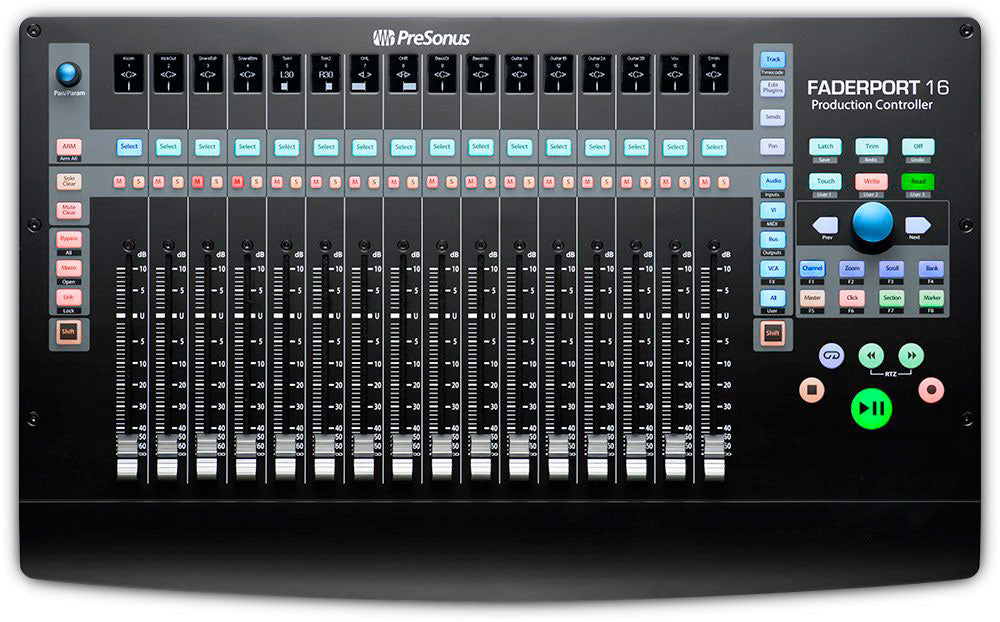
Presonus Faderport 16 allows you to have
tactile control of your digital workstation and it does so through its
16 touch-sensitive 100 mm motorized faders, comfortable and with a very precise throw (10 Bit / 1,024 steps). In addition, it includes
89 buttons covering 104 different functions – level, pan, solo, mute, track recording mode activation, transport control, automation modes, among others–, all in a compact chassis that integrates perfectly into any studio.
As we have mentioned, it is not a mouse replacement but, rather, a complementary and at the same time essential tool if you want to
mix quickly and effectively.
At the same time, the surface has a
rotary encoder that, together with the complementary buttons, provides you with
practical access to basic functions such as timeline scrolling, zoom in/out, navigation markers, track size management, or general output level control.
The system integrates a
USB-2.0 connection port. It comes with native support for PreSonus Studio One and also for Mackie Control Universal and HUI protocols –the latter will allow you to link the
Faderport with Pro Tools, for example–.
In this way, the Faderport series, which started with the revolutionary single-channel control device, is completed with a 16-channel system that allows you to develop
more complex configurations and take on more demanding sessions.
To close this series of presentations directly related to the studio product family, we are going to mention a prestigious English manufacturer recognized worldwide for its microphone preamplifiers. We are referring to
Audient, which presented at NAMM with a new member for its successful family of
audio interfaces, the
Audient iD 44.
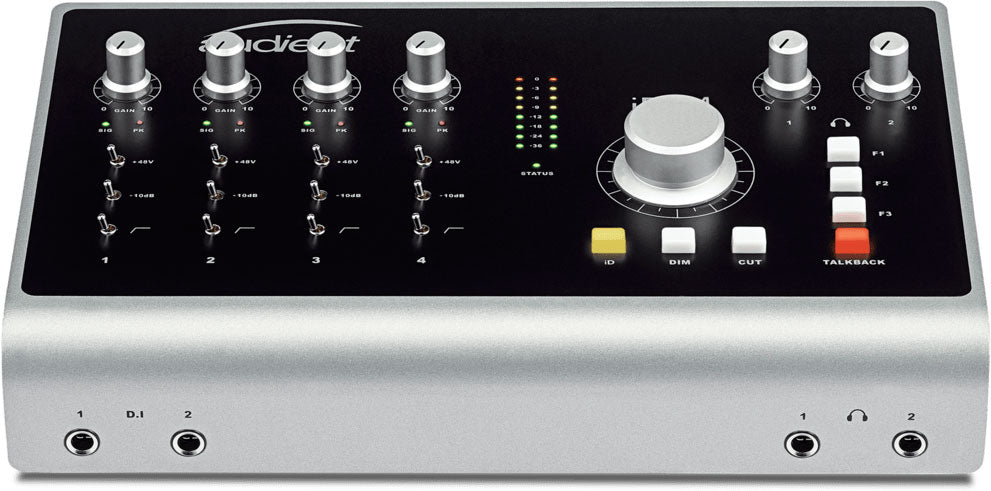
Audient's microphone preamplifiers, derived from the renowned consoles designed by this same manufacturer, are not only highly valued for their
clarity, low noise and distortion and high common-mode rejection at all gain levels but also for their great
versatility which is a consequence of their
wide dynamic range.
As the manufacturer himself indicates, Audient always uses the same
Class A microphone preamplifier design in its entire product range, therefore, the new
Audient iD 44, as it could not be otherwise, also includes them. In this case, they are
four microphone preamps with the same discrete circuit design that is found, for example, in
the revered ASP8024-HE recording console. These preamps are characterized by the
great clarity and musicality that their design gives them for an optimized gain range between 0 and 70 dB, their very low noise level, their wide bandwidth and their transformerless input stage –which protects and isolates them from possible radio frequency interference–.
On the other hand, these excellent preamps come with
high-quality Burr-Brown AD/DA converters that provide a more natural and organic representation of the source, both in recording and mixing.
In addition to a
greater number of inputs and outputs than the rest of the interfaces in the iD family, this desktop audio interface, with
20 inputs and 24 outputs, includes
2 ADAT input and output ports for digital expansion –with which you could add
up to 16 more channels of microphone preamps–, 2 discrete JFET instrument inputs, 2 balanced insert points, 2 independent stereo headphone outputs, a pair of outputs for the main speakers and another pair of outputs for a second reference system.
At the same time, this new
24bit/96khz USB 2.0 interface also offers the practical and intuitive function called
Scroll Control, which allows you to
convert your volume control into a virtual scroll wheel. In this way, you can control different parameters such as, for example, plugin settings, automations and other features of the DAW itself, and even navigate through the iTunes library, all through a tactile, comfortable, intuitive and very precise control.
On the other hand,
Audient iD 44 also incorporates 3 user-definable function keys, specific controls for Talkback, Dim and Cut,
low-latency DSP mixer, Word Clock output and a powerful
free software and plugin package, among which are: Eventide Ultrachannel and Ultrareverb Plugin, Steinberg Cubase LE and Cubasis LE2 for iOS –all accessible
by downloading from Audien's ARC.
A good controller keyboard is a very common tool in a recording and/or production studio. It is an intrinsic part of the landscape of a studio, just as happens with a mixing console or reference monitors. So, before closing this group of presentations, we will tell you some of the most interesting features of the brand new
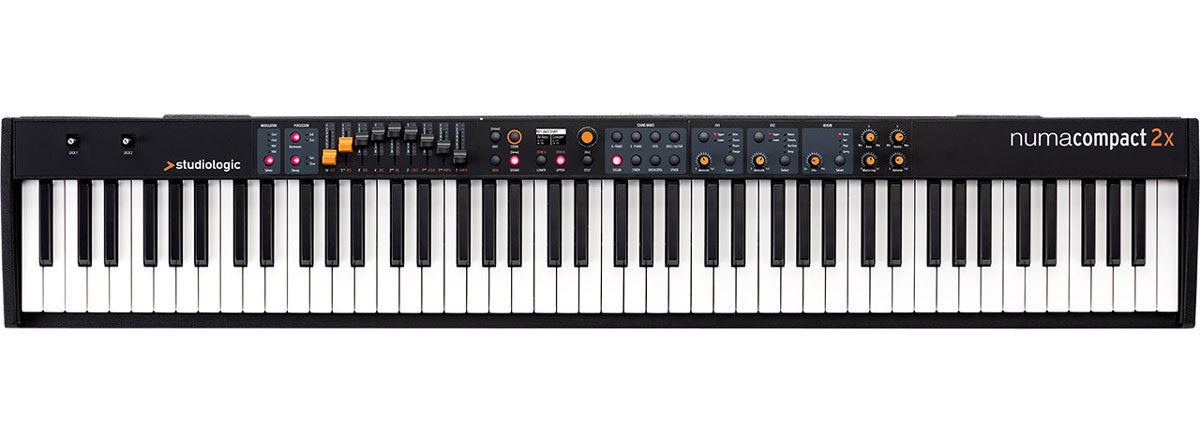
Numa Compact 2X, designed by the
veteran Italian company Studilogic.
Thanks to its famous
Fatar controllers –with its patented hammer-action keyboard–, the introduction of the
conductive rubber contact in 1990 –which made the traditional spring contact obsolete– and the Studiologic Studio 88, a
pioneer in the “Master Keyboard” segment, this company has forged an excellent reputation in the market. Currently, it continues producing its own brand of MIDI controllers and supplies keyboards for third-party manufacturers, such as the case of the
Waldorf Quantum synthesizer, which we will talk about below.
In the recent edition of
NAMM 2018, Studiologic launched this particular keyboard that, in addition to working as a controller, does many more things. It is an
88-key TP/9 PIANO device with semi-weighted action with aftertouch, which carries the seal of Studiologic master keyboards and, in addition, provides you with an
interesting arsenal of sounds along with a
wide variety of features.
Numa Compact 2x has 3 new engines that provide 88 Sounds –8 acoustic pianos, 8 electric pianos, 8 keyboards, 12 basses and guitars, 12 organs –a Hammond-type organ model derived from Numa Organ–, 12 synthesizers, 12 orchestral and 16 more of different styles–.
It incorporates a
Sledge sound synthesis engine –optimized to create any synthesized sound from a library of basic waveforms–,
1GB of sample and effects memory (Drive, Chorus, Phaser, Flanger, Rotary, Tremolo, Pan Trem, Delay, Reverb and Strings Resonance on all piano sounds)
On the other hand,
it integrates a 128 x 64 dot OLED screen, encoder with push function, 7 potentiometers, 23 buttons and 9 programmable sliders that can be used as
Drawbars to control organ sounds and, also, as linear controls to send MIDI CC. The USB port transmits and receives high-quality digital audio. In this way,
you can use the Numa Compact 2x as an audio interface to send sounds to the computer
or to amplify the digital audio signal coming from it through the
2 full-range elliptical speakers –with a built-in 10 + 10W digital amplifier–.
In summary,
Numa Compact 2x is a flexible, compact and lightweight keyboard (it weighs only 7Kg) and suitable for any musical environment or setup.
Next, and taking advantage that we just touched on this topic, we will proceed to dive headfirst into synthesis. We will do it, to start, with a manufacturer that never goes unnoticed. Think of the stir it caused among users of all kinds with its first foray into the mythical universe of
analog synthesizers with its
DeepMind series.
So, this German manufacturer has taken advantage of this new call of NAMM to present its
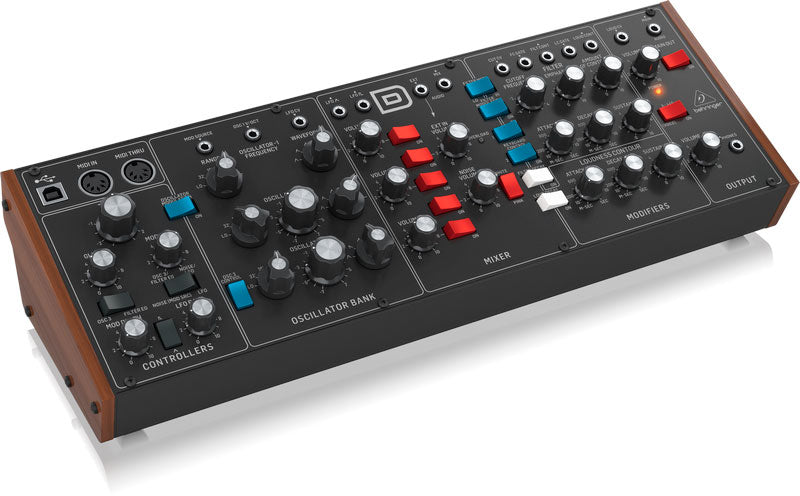
Behringer Model D, an
analog synthesizer with 3 VCOs,
ladder filter, LFO and Eurorack format, strongly inspired by the legendary designs of
Moog, a sort of ultra-economical tribute to the iconic portable analog synthesizer of the 70s that combines features of the Minimoog Model D and the Moog Mother 32.
That said, it must be noted that all these products are different from each other and, beyond the logical comparisons that can be made, in this article we will limit ourselves to highlighting the particularities and features of this
new venture from Behringer.
One of the most interesting features of this
monophonic and semi-modular analog synthesizer is the possibility of chaining, through the
Poly Chain function, to other Model Ds. In this way,
you can combine multiple synthesizers to achieve a polyphony of up to 16 voices.
On the other hand, the system provides
a pure analog signal path that is based on authentic filter designs
VCO, VCF, VCA and ladder, along with a dedicated fully analog triangular/square wave LFO. The 3 voltage-controlled oscillators (VCO)
offer 5 waveforms with variable pulse widths so you can shape your ideal sound. Likewise, the 3 VCOs can be adjusted in an extremely wide range of 6 octaves (LO, 32 ', 16', 8 ', 4' and 2 ').
As it could not be otherwise, the synthesizer
includes a classic 24 dB ladder filter with resonance, which allows you to experiment freely with the cutoff frequency, emphasis and contour so you can access that legendary sound.
Regarding its sound, the
Behringer Model D incorporates the true
original "Type D" circuit with its combined transistors and JFET, high-precision thin-film resistors (0.1% ) and polyphenylene sulfide capacitors. All this gives it the ability to shape an
ultra flexible sound, which goes from super thick lows and punchy tones, to impressive effects, passing through progressive organ sounds and everything you can think of.
The device also includes 48 controls for direct and real-time access to all important parameters, audio input to process external sound sources and full MIDI implementation.
Due to its
semi-modular design, it is not necessary for you to make patch connections, you can start playing from the first moment. The device
can be mounted on a standard Eurorack, so it is ideal for the studio or for going on tour.
Finally, another of the great advantages is, obviously, the possibility that Behringer offers you to get a synthesizer of this type for
an extremely competitive price –always faithful to its philosophy based on the motto “twice the features for half the price”–.
We move on to the next novelty within the synthesizer family. In this case we detail the most outstanding of
Waldorf Quantum, an
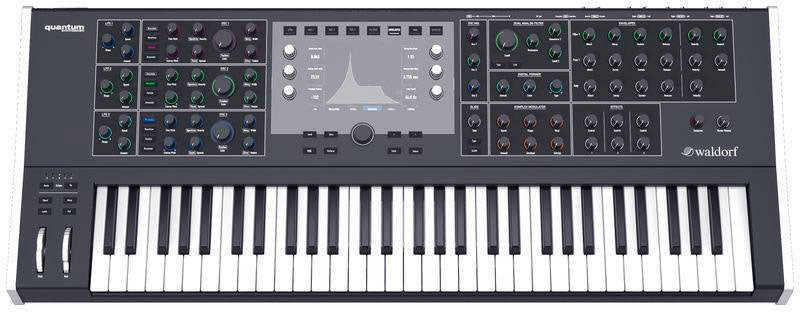
8-voice hybrid synthesizer with 61 Fatar TP8S keys that, although it was announced during the first quarter of last year, it has not been until now when its specifications have finally been confirmed and it has gone on sale.
This instrument, with a
digital/analog hybrid architecture, follows the iconic design line of
Waldorf's innovative high-end synthesizers and includes its
renowned wavetable technology.
As for the sound, it
combines 3 stereo digital oscillators, each capable of four synthesis algorithms –waldorf-style wavetables, classic synthesizer, granular sample, and resonator–,
plus two analog low-pass voice filters (each in a 24 or 12 dB configuration)
and a digital filter that adds additional digital algorithms (comb filter, high-pass, band-pass, and notch filters) per voice. All combined with
6 LFOs in poly and global mode –with a wide range of parameters– and 6 conventional envelopes with a loop mode option.
Its 8 voices can be split or layered multitimbrically for greater sonic versatility. At the same time, Waldorf Quantum includes a
large touchscreen for more detailed sound visualization and editing, top-panel controls (Arpeggiator and Step Sequencer), 5 master effects with separate sections for each timbre, internal memory plus an expandable SD slot for firmware and samples, and a wide variety of inputs and outputs that include, among others, stereo and auxiliary audio outputs, a headphone output, a USB connector, and MIDI IN/OUT/THRU.
The German company has also surprisingly introduced the
Waldorf STVC. It is a
string synthesizer with a vocoder and a 49-note keyboard with aftertouch and velocity, based on the popular Streichfett string synthesizer from
Waldorf itself.
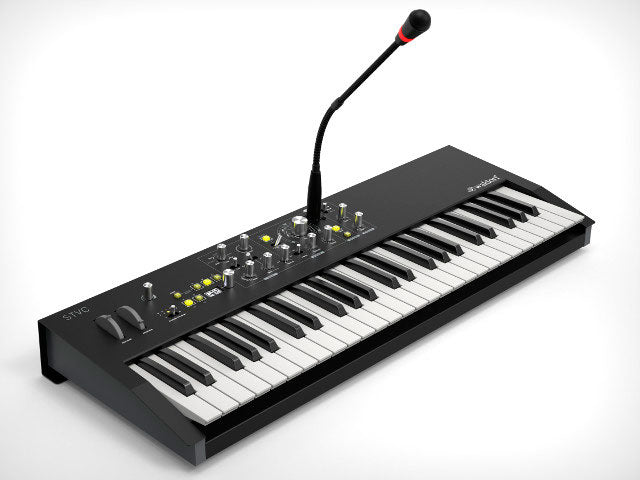
The layout of the elements that make up the instrument begins with a bank of oscillators using octave dividers, followed by a powerful mixer, an equalizer, and the effects section.
The section called “Solo” consists of a
16-voice synthesizer that complements the string sounds. A single rotary control allows you to choose between the different timbres.
As for the
vocoder, it offers a mode that
allows you to freeze a short voice fragment –which the vocoder then repeats every time a key is pressed–
and excellent speech intelligibility by using the fully polyphonic oscillator bank.
The innovative Tweak feature allows the modification or modulation of certain details such as, for example, the cutoff frequency, or the Chorus LFO ratio.
The
STVC is equipped with pitch bend and modulation wheels in a completely metal chassis that also features a
128x64 OLED screen that provides easy access to the
126 programmable patches divided into three banks. STVC also comes with 10 potentiometers, 1 encoder, 9 backlit buttons, 5 switches, and
includes a high-quality gooseneck microphone (44 cm long with an LED indicator), which connects directly to the front panel.
We continue with more synthesizer news, although with substantially different products.
We move on to the flashy
Elektron Digitone, a peculiar
8-voice polyphonic digital synthesizer with a 16-step sequencer and multiple FM algorithms, which promises to revitalize and modernize synthesis, for example, by combining FM sound generation with a classic subtractive synthesis signal flow.
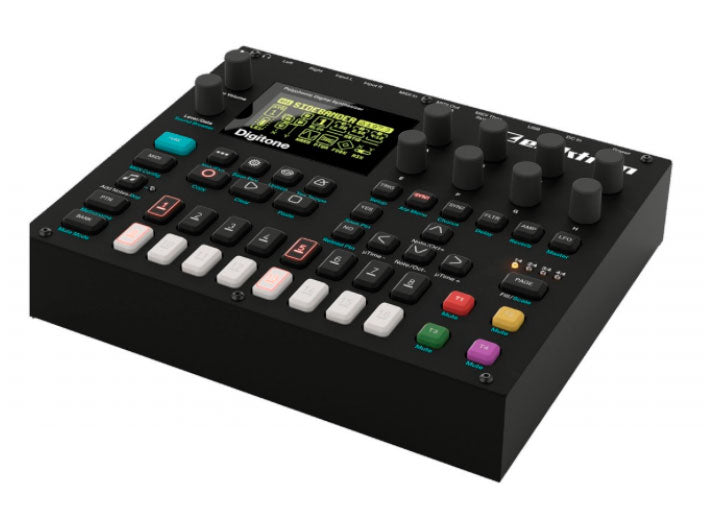
Elektron Digitone comes with various FM algorithms whose parameters have been carefully selected so you can achieve truly attractive and original sounds without overcomplicating things.
512 sounds ranging from FM classics to the most extravagant and extraordinary soundscapes created by Blush Response, DivKid, Hizmi, Mark Fell, Zabutom, Elektron's own staff, and many more.
According to the manufacturer, the
intuitive design of Elektron Digitone seeks to
make the synthesis process easy –a way to create extraordinary sounds that, however, is often complex–. This is the idea that the designers of
Digitone started with when they got down to work on this new instrument.
Elektron Digitone aims to offer the full depth of FM synthesis, but by streamlining it and making it more accessible.
With
practically unlimited creative potential, Digitone features four tracks with its own
4-operator FM synthesizer engine with eight algorithms. Each track also has its own arpeggiator, and the built-in effects include chorus, delay, reverb, and overdrive. It also features a
sequencer similar to the Digitakt –the other model in the series–.
In summary, Elektron Digitone offers you an
8-voice FM synthesizer with a sequencer, 4 synthesizer tracks –each with a 4-operator synthesis engine with 8 algorithms–, 4 MIDI tracks for sequencing external equipment, powerful Elektron sequencing with parameter locking, 2 LFOs per voice, 1 arpeggiator per track. The built-in effects include Panoramic Chorus, Saturator Delay, Supervoid Reverb, and Overdrive Master Effect.
As with most Elektron hardware,
the Digitone works with its own Overbridge software, which provides seamless integration with the computer.
To close this second article about
NAMM 2018, we will also end with a synthesizer. It is a product that, due to its very distinctive characteristics, not only
greatly stimulates your spontaneity and creativity but also allows you to enrich your setup with genuine and powerful sounds. We are referring to the
Teenage Engineering Pocket Operator PO-33 K.O, a micro sampler with
the ability to sample up to 40 seconds from any source, whether using a cable or through its
built-in microphone.
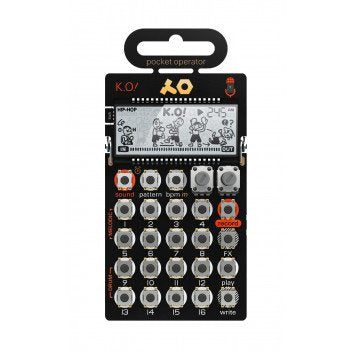
This unique
pocket sampler, in addition to offering you the option to sample anytime and anywhere, also includes
8 melodic sample slots (to play sounds chromatically),
8 for drums, a
16-step sequencer,
16 effects, a parameter locking function, Jam sync connectivity to sync it with other Pocket Operators, a
built-in speaker for true portability, audio input and output with a 3.5 mm jack, an animated LCD screen, and a folding stand. The PO-33 is powered by 2 AAA batteries and works as an alarm clock, and although its design might lead you to think it does, for now, it does not include a calculator.
In this way, we reach the end of this second part of our review of the most outstanding novelties from this edition of NAMM 2018. But there's more, we still have the third and final part, so don't miss following us on our blog and social media.
There is still a lot to talk about regarding NAMM 2018!
If you need more information about this or other promotions offered by
Microfusa, do not hesitate to
contact our team, we will be happy to help you.
MICROFUSA / BARCELONA STORE
Sepúlveda, 134. Barcelona / Tel.: 934 553 695
MICROFUSA / MADRID STORE
Ardemans, 9. Madrid / Tel.: 917 242 800
MICROFUSA / ONLINE STORE


