Are you starting your journey as a DJ? At microFusa, today we bring you a few tricks and tips that will surely help you get started in this exciting world
At microFusa, we are pioneers in DJ products in Spain. That is why we have the most diverse DJ equipment in our stores in Barcelona and Madrid and in our online store, from the best brands. And also for that reason, in a way, we have developed a responsibility towards those who are starting in this little world.
During the peak of disco and hip-hop music, club culture became popular at the same time as specific DJ technology advanced by leaps and bounds and became more affordable. Today, anyone can start mixing without the need to make a large investment. It is not crazy to get a semi-professional controller, and there are free tools and software with which to get very good results. But if you really want to start a DJ career, it is not enough to start mixing and get carried away making mixes. There is much more behind the DJ. And today we are going to give you some tips and tricks to make the path easier.
A musical education is basic
It may seem obvious, but it really isn't. If you want to build a career as a DJ, you need a good musical education. And this must cover two aspects. On one hand, you must have a good knowledge of the latest musical trends. Do not limit yourself solely to the style/styles you like. It is a good idea to follow the career of the artists and producers who are most interesting.
But on the other hand, you also have to stay up to date on the latest advances in hardware and the new music-related software programs. You have to be constantly up to date.
Practice, practice, and when you finish, keep practicing
It is clear, right? Do not expect to become a great star on the dance floor overnight. Today, many DJs go on stage without having the necessary preparation. You cannot make a bigger mistake. Before thinking about your debut, improve your skills to the maximum.
Make as many mixes as you can. You, a mixing table, and two platters. You do not need much more. Of course, then seek constructive criticism from your friends.
Do not hesitate to ask for help
When you start as a DJ, one of the things that seems scariest is asking for help. But the truth is that you will always find people willing to help. And nothing bad will happen because you do it. On Facebook, Instagram, Twitter, and Tumblr, you can find groups dedicated to helping DJs. There is always someone out there who knows the answer, and after the first time, everything will be easier.
Be serious
This is also basic: be serious, responsible, and above all, punctual. When you have meetings, when you meet with other artists, when you perform at a club or a party, when you write on a blog, when you promote a song, or when you have to meet a deadline. Whatever it is, always be serious, responsible, and punctual.
Despite the great popularity that music and DJs enjoy, it is not such a big world, and you never know how your behavior can affect your reputation.
You are not going to be just a DJ
To be a good DJ, it will not be enough to be good at making mixes. You will have to be good at many other things. The reason is simple. To start, there are many other tasks in which you will have to work hard to become recognized. It is difficult to specify what tasks they will be. Each person will have their circumstances. But to give you an idea, you may have to learn to make mashups, produce your own music, write articles and tutorials, conduct video interviews, act as a manager, work on the radio, prepare your own website, manage your social media, answer emails and messages from followers, etc. In the end, mixing is just a small part of the DJ work.
Establish a network of contacts
An online network of contacts can be a great way to get support and help. On Soundcloud, you can find people who DJ in your city, you can follow your favorite musicians on Twitter, or talk to the artists who have just performed at a club. A network of contacts can give you support and help you learn.
Some technical tricks
Use the right EQ
On your mixer, you will have 3 to 4 equalizers on each channel, one of the most valuable tools for DJs. And for them, there are two very important rules:
1- Unless you are making adjustments, it is practical to keep the EQ at 12:00 as default. EQ is better than unit gain. Stabilize it at 0db when possible.
2- The technique of cutting a signal is preferable to boosting it. If your first instinct is to turn up the bass, first try reducing the mids and highs a little and then the channel gain as necessary. It can also be useful to use a “sub-bass” source at the same time. Playing several tracks at once along with a heavy “sub-bass” tempo can create an unclear mix. Generally, playing like this on a large sound system is confusing, but the EQ can be a great tool. As you mix tracks together, lower the bass to keep the sound clear and concise. The “crossfaders” will help you mix the two tracks, or you can also change the bass lines with the EQ buttons for a better audience reaction.
Stay out of the red zone
Before playing your set as a DJ, try to get the best sound quality by checking your signal inside and outside the mixing table. But remember to stay out of the red zone. It is a fairly basic rule, but it can happen from time to time. To do this, it is key to know that pushing the button into the red zone will distort your sound. This also tends to be very uncomfortable for your audience. Given that most venues have limiters at the end of each signal, you do not need to modify your mixer beyond 0db because it will not have an effect on the volume anyway. Stay alert about your volume, adjusting the levels and equalization controls.
Do not overdo the effects
It is important for a DJ not to overdo the effects. Some use many effects to facilitate the transitions from one track to another and to improve the sounds and performance. But that will make your music superficial and oppressed.
Press sync
The easiest way to facilitate the transitions between the different tracks, speeding up the process and skipping hours and hours of testing and trying, is found in the SYNC key. Most applications have this option that automatically synchronizes the tempo and the bpm of the songs.
Some tools to start
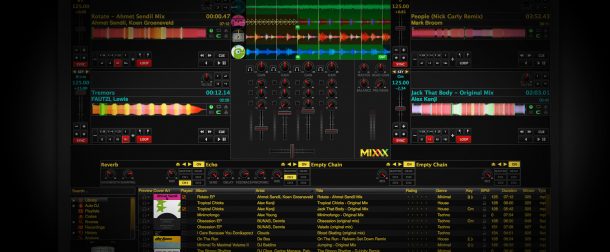
Mixxx
Free software application, multiplatform, even available in the App Store. It only accepts MP3, MP4/AAC, FLAC, and OGG formats, but it integrates with iTunes.
The BPM synchronization is quite good. It also has a vinyl emulator. It allows us to record our sessions, broadcast them, and, obviously, use the typical equalizers, mixers, hotcues, or loops.
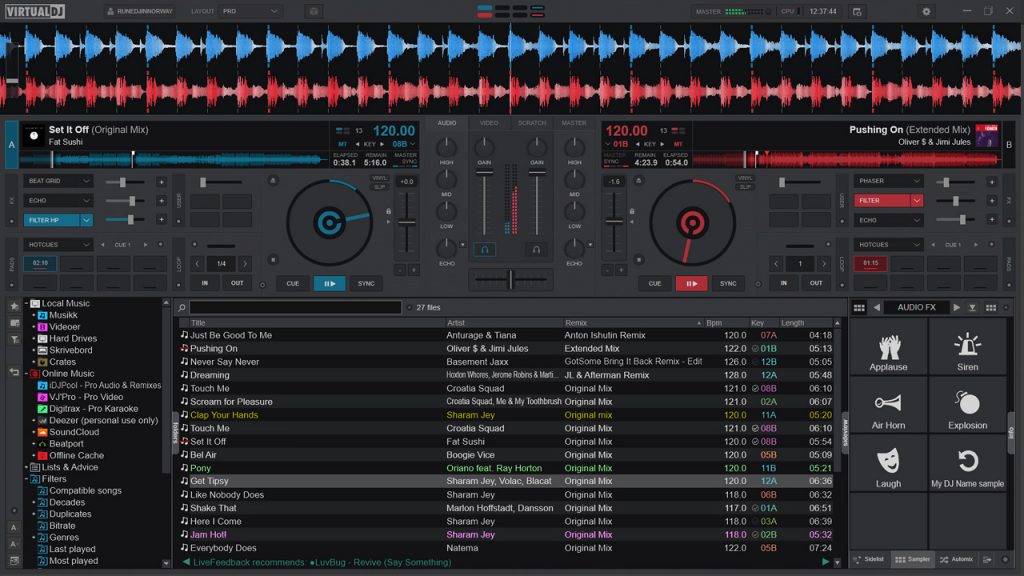
Virtual Dj
Starter application that has a very simple interface, it does not need a controller. Its biggest disadvantage is that it uses a lot of computer CPU, and causes it to sometimes be unstable.
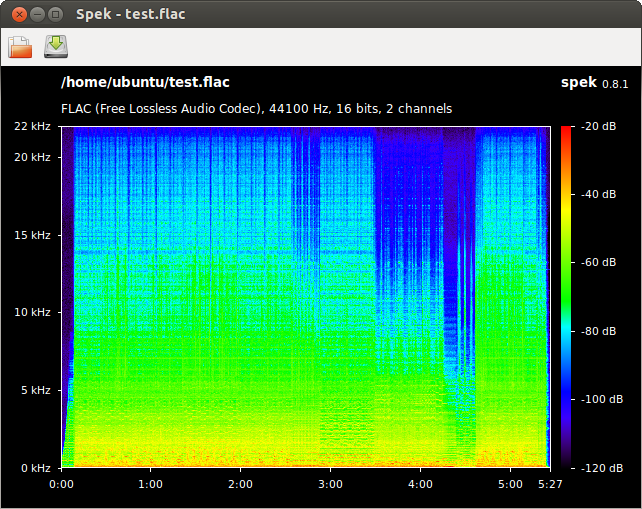
Spek
Spek is a completely free tool that allows us to analyze audio files by showing their spectrogram. Fundamental to analyze and know what quality your set has.
Abbleton Live
One of the best platforms to produce your music professionally.
https://www.youtube.com/watch?v=VSGYqvV4bTg&feature=emb_logo
Controllers for beginner DJs
The Pioneer DJ DDJ-200 is the new smart DJ controller, compatible with Smartphones, ideal for beginners. Designed thinking about beginner and/or amateur DJs, this controller is compatible with a variety of music streaming applications, offering access to features that demystify many aspects of the craft. Ideal to start mixing thanks to the Tutorial function of the application, WeDJTM for iPhone (ver. 2.0), which you can download for free from the App Store.
https://www.youtube.com/watch?v=nO_3welHyk0&feature=emb_logo
With its large low-latency platters, specific pad and transport controls, integrated sequencer, and mic input with professional voice effects, the Roland DJ-202 includes more features than any other controller in its category. It is a new 2-channel and 4-deck controller for Serato DJ with features and design typical of high-end controllers. It retains the concept of its older siblings and incorporates a sequencer for creating beats and remixing tracks live, with eight sounds in each Kit TR: Bass Drum, Snare Drum, Closed Hat, Open Hat, Tom, Rim, Clap, and Ride, independent sampler volume, eight specific pads: Drum, Closed hat, Open hat, Tom, Rim, Clap, and Ride.
https://www.youtube.com/watch?v=7egbc44dhS0&feature=emb_logo
And remember that in our
DJ Equipment section you will find everything necessary to get started in this exciting world: from controllers and digital systems to professional CD players, turntables, DJ headphones, mixing tables, and accessories of all kinds.


