


Delay, reverb, chorus, flanger, or looper? Take a look at the different creative pedals we present to you and find the one that's right for you.
We have a new category of Creative Pedals in our online store and to help you choose the best option, according to your project or style, we have created this guide with special recommendations from our experts.
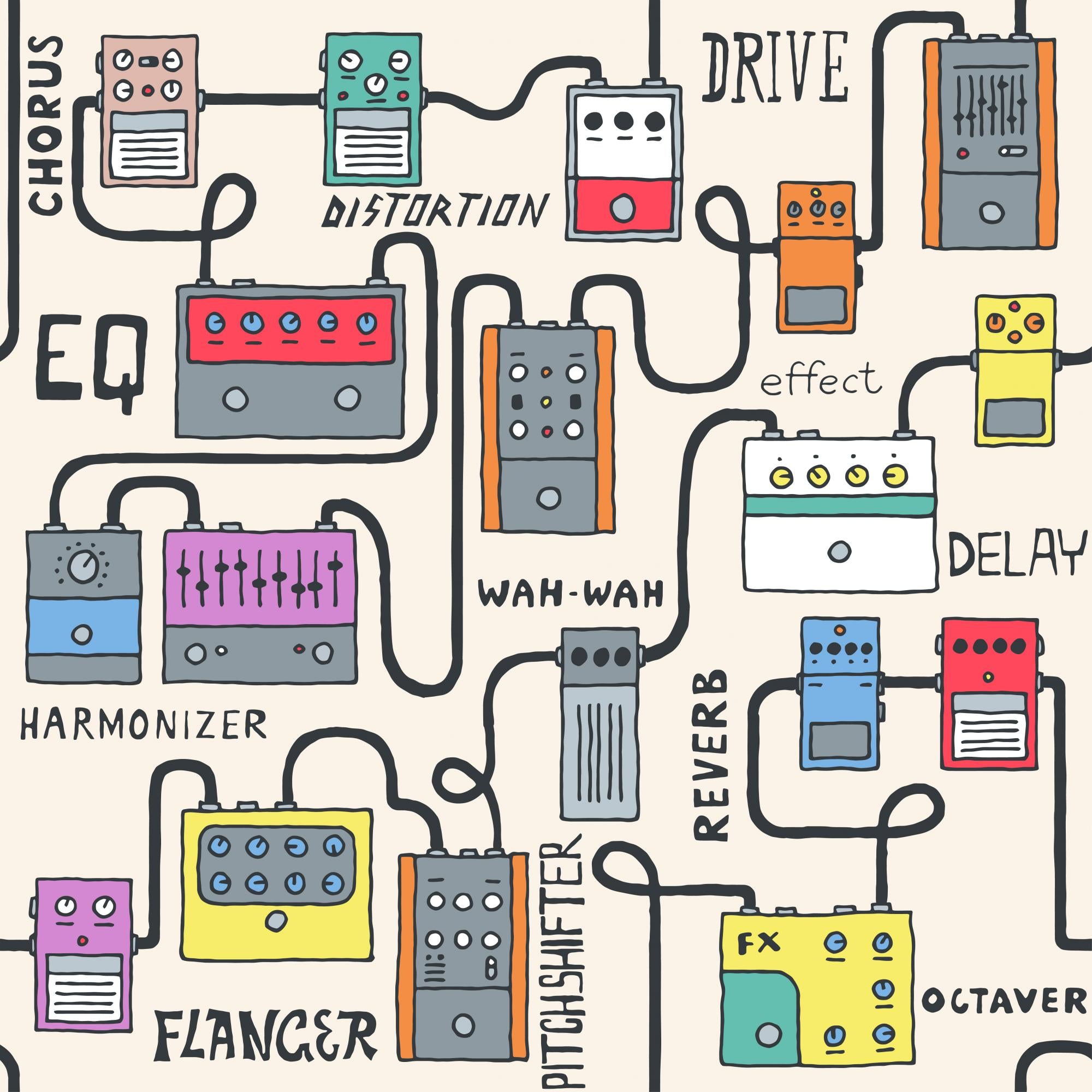
An effects unit or effects pedal is an electronic or digital device that alters the sound of a musical instrument or other audio source. Among the most common effects are distortion/overdrive, often used with electric guitar in electric blues and rock music;dynamic effects such as volume pedals and compressors that affect the sonority; filters such as wah-wah pedals and graphic equalizers, which modify the frequency ranges; modulation effects, such as chorus, flangers, and phasers; tone effects; and time effects, such as reverb and delay, which create echo sounds.
Most modern effects use solid-state electronics or computer chips. Some effects, particularly older ones, such as Leslie speakers and spring reverbs, use mechanical components or vacuum tubes. Effects are often used as pedals that are normally placed on the floor and controlled with foot switches. They are also built into amplifiers, tabletop units designed for DJs and record producers, rack mounts,, and are widely used as VST software.
Musicians, audio engineers, and record producers use effects units during live performances or in the studio, generally with electric guitar, bass, electronic keyboard, or electric piano. While guitar effects are more frequently used with electric or electronic instruments,, effects can also be used with acoustic instruments, drums, and vocals.
This effect is used to imitate natural reverberation, creating a sense of depth and space. Without a reverb effect, guitar tone can often sound like it is too close and "dry," which sounds unnatural since reverberation exists in natural spaces. Reverb, in essence, is the persistence and continuation of a sound after it is produced. That persistence of sound is created by sound waves that reflect off the surfaces of a room. The final decay of the sound occurs when the sound waves are absorbed by objects in the environment, including walls, curtains, people, and furniture. Different objects have different characteristics that reflect and absorb sound. For example, clapping your hands in a bathroom with ceramic tiles will sound very different from clapping your hands under a blanket. The reason for this is that ceramic tiles in your bathroom reflect and absorb sound differently than a blanket.
Reverb is one of the first effects created for guitarists, originally built into the amplifier itself, such as the Fender Deluxe Reverb and Super Reverb. Traditional spring reverbs actually send the signal to the springs, making them vibrate and simulate reverberation. With the advent of digital technology, reverb unit pedals broke into the market, mainly as rack units, but as technology improved and shrank, many of those units can now fit into a pedal.
microFusa Recommendations: Neunaber Immerse Reverberator, Meris Mercury 7, Boss RV6, Electro Harmonix Oceans 11, and Strymon Bluesky. [video:https://youtu.be/70oVouoJMrQ align:center]Digital delay pedals were introduced to the market by Boss in 1984 with the Boss DD-2. Since then, as technology has advanced, delay pedals now offer many features in a very small box, such as tape echo, analog, reverse delay, modulated delay, and loops. The main difference between analog and digital delays is the delay time and the clarity of the note. Digital delays can produce delay times of several seconds, while the Deluxe Memory Man offered a delay time of 550 ms. Digital delay units also introduced the tap tempo function, which is extremely useful when using delay as a rhythmic tool.
Some delay pedals try to replicate an incoming signal as accurately as possible, while others color the signal to achieve a specific sound delay (i.e., tape echo). Regardless of the sound the delay effect is using, its control parameters and musical uses generally remain the same.
microFusa Recommendations: Electro Harmonix Grand Canyon, Strymon Timeline, Eventide Timefactor, Strymon Brigadier Delay, and TC Electronic Flashback. [video:https://youtu.be/Z7-w-UpO3U0 align:center]Chorus effects pedals create another class of modulation effects that people often confuse with flangers and phasers. Technically, a chorus effect is very similar to a flanger, only with a different sonic goal. While the chorus effect is not discussed as often as some of the most popular effects such as overdrives or delays, it is actually a very important effect, especially if you play a lot of classic rock. The goal of a chorus effect is to imitate the sound of a chorus, hence the name. In a chorus of human voices, there will always be small variations in pitch and timing, since human beings are not perfect musical machines. To achieve this same effect in a chorus pedal, the incoming signal is split into several different voices with additional time and pitch variations.
These are the three main adjustable parameters in chorus effects: voices (how many times the signal is split), delay (how much delay time the duplicated voices will have), and tone (how much the voices vary in pitch). The flanger is one of the most distinctive effects that exist, known for its jet-like sweep sounds, it can also be very subtle as David Gilmour and Andy Summers have shown. It is similar to a chorus pedal because it is a modulation time-based effect. The flanger delays a copy of the original signal and mixes it with the dry signal. The time shift causes the swooshing effect. This can be done in several stages to produce a more dramatic effect.
microFusa Recommendations: Neunaber Inspire Tri-Chorus Plus, BOSS CH-1, Moog Minifooger Flanger, BOSS BF-3, and Strymon Ola Chorus. [video:https://youtu.be/Q7w8H6ZKvTE align:center]The term overdrive refers to when a tube amplifier is pushed beyond its range to provide a clean tone. A common question is "what is the difference between overdrive, distortion, and fuzz since the terms have become interchangeable?" The short answer is not much, only one is more extreme as we move down the line. Distortion pedals can often have a kind of identity crisis; many of them can be dialed in as a fuzz or overdrive pedal, and some can even be adjusted to fulfill all three roles of overdrive, distortion, and fuzz. Although many prefer to own a pedal that is a little more versatile, most of the time, a pure distortion pedal will sound and perform better than a pedal made to fulfill multiple functions.
Distortion is easy to see as simply more saturation, these tones are more saturated and compressed. The spectrum of saturated tones is huge, from the slightly overlapping tube amp tones of BB King, to Eddie Van Halen's Marshall, the thick distortion of Metallica, to the fuzzy tones of Smashing Pumpkins. In reality, it is all the same idea in a general sense, these tones can be obtained with amplifiers, pedals, or a combination of both, but it is the same idea, overdrive. What was considered a strong distorted tone in the 70s is foreign to today's metal sounds.
microFusa Recommendations: BOSS OD-3, Electro Harmonix Big Muff Pi Tone Wicker, Gamechanger Audio Plasma, Strymon Sunset Dual, and BOSS DS-1.
[video:https://youtu.be/ceXxA4qxlSM align:center]Even in the early 1990s, when loop machines came out, the term "live looping" had not yet been coined. The first dedicated loop device was the Paradis LOOP Delay. The Paradis and other models had volatile memories, which forced composers to develop new live loops in front of their audiences, and thus live looping was born. Roland and Digitech loop pedals entered the market in 2001, almost at the same time that DJ mixing gained popularity. When the 2002 Repeater introduced real-time studio looping, loop devices became affordable enough for aspiring home composers to enjoy it.
Live looping has become increasingly popular in recent history since it offers the possibility of a single musician creating multiple layers of their music live, resulting in a sound similar to a "full band". Notable manufacturers of loop devices are: Boss Corporation, DigiTech, TC-Helicon, Boomerang, Electro-Harmonix (EHX), Line 6, Pigtronix, TC Electronic (Ditto), and Vox.
microFusa Recommendations: HOTONE Wally Plus, BOSS RC-1, Electro Harmonix 22500 Dual Stereo Looper, BOSS RC-300, TC Electronic Ditto Stereo Looper, and BOSS RC-505.
[video:https://youtu.be/FcpG41M0VGI align:center]A pedal tuner is basically a digital tuner that can be easily chained into your effects setup. There are a number of options available for a musician looking for a pedal tuner, most of which include chromatic tuning, meaning you can tune any instrument, not just your guitar or bass.
Harmonizers change the pitch of the played note by a user-specified amount. The range of pitch deviation depends on the equipment used, but many pedals are capable of raising and lowering the pitch two octaves above and below the fundamental pitch. The amount of pitch deviation can be set or controlled by a pedal (which generally offers smooth and continuous control of the pitch). Normally, this function will be used with the original signal, which will result in a Harmonizer: the pitch is modified and combined with the original pitch to create two or more harmonies of notes. These harmonies are typically programmed in discrete integer multiples of the fundamental pitch.
When used with an expression pedal, it provides a smooth, slightly digital effect, similar to a curve. Pitch changes can also be used to electronically "detune" the instrument.
microFusa Recommendations: BOSS VE-2, TC Electronic Polytune Clip, HOTONE Tuner, BOSS TU-3W, and TC Electronic Polytune Mini 2 Noir.
[video:https://youtu.be/MNfZwI_ZlHE align:center]These guitar pedals are effects processors that allow you to emulate the sound of a synthesizer. After activating the guitar effects unit, the guitar's output signal is taken and processed by the synth pedal, changing the overall sound. These processing units are commonly used in both live performance environments and studio recording sessions.
Unlike other pedals that one would consider more essential, such as tuning pedals, synth pedals cannot be so easily swapped for a replacement, unless it is the same model, since each synth guitar unit will have a unique circuit that will achieve a different sound. This makes it extremely important for a guitarist to choose a reliable synth processor, since they will need to use this particular model in their live performances, especially if it has been used in recorded material.
microFusa Recommendations: Meriz Enzo, Digitech SDRUM, Electro Harmonix Mel9, Electro Harmonix 8 Step Program, and Electro Harmonix Microsynth. [video:https://youtu.be/AEB-HyNV6LU align:center]In addition to pitch correction and harmonization, these top-rated processors are useful for adding other effects such as reverb and compression, or for completely transforming your voice, whether into robotic / strange sounds, different ages or genders, and much more. They serve as a team of virtual sound engineers, vocal coaches and backing singers, all packaged in a single unit.
Vocal effects enhance and expand the sound a singer can achieve when performing live or in the studio. By using vocal effect pedals, a singer can take their sound to the next level, adding a professional edge to their performance. Reverb and compression can help make vocals stand out in a live mix, as well as add space and atmosphere. Singers can get creative by adding Distortion, Chorus, Octave and Harmonies and much more, transforming the voice into a complex instrument in its own right.
microFusa recommendations: BOSS VO-1, Roland Aira VT-4, Radial Engineering Vocoloco, Electro Harmonix Vocoder and TC Helicon Talkbox Synth.
[video:https://youtu.be/G4D9MwTJSUY?list=PLjE3lpIJr8X2NqvRa5VmXkJY5lT4mb3UR align:center]These devices offer us a variety of the examples seen above so that we can combine them and make the most of our sounds. Here are the microFusa recommendations: MOD Devices MOD DUO, HOTONE Ampero, ZOOM G1X Four, Headrush Pedalboard and Line 6 Helix Floor.
[video:https://youtu.be/VmLH95NdgAY align:center]These are microFusa's recommendations to help you find the right pedal for your project or style. We invite you to visit our physical stores so you can try the pedals you like, or visit the Creative Pedals section of our online store.
If you need more information about this or other products offered by Microfusa, do not hesitate to contact our team; we will be happy to help you. MICROFUSA / BARCELONA STORE Sepúlveda, 134. Barcelona / Tel.: 934 553 695 MICROFUSA / MADRID STORE Ardemans, 9. Madrid / Tel.: 917 242 800 MICROFUSA / ONLINE STORE