

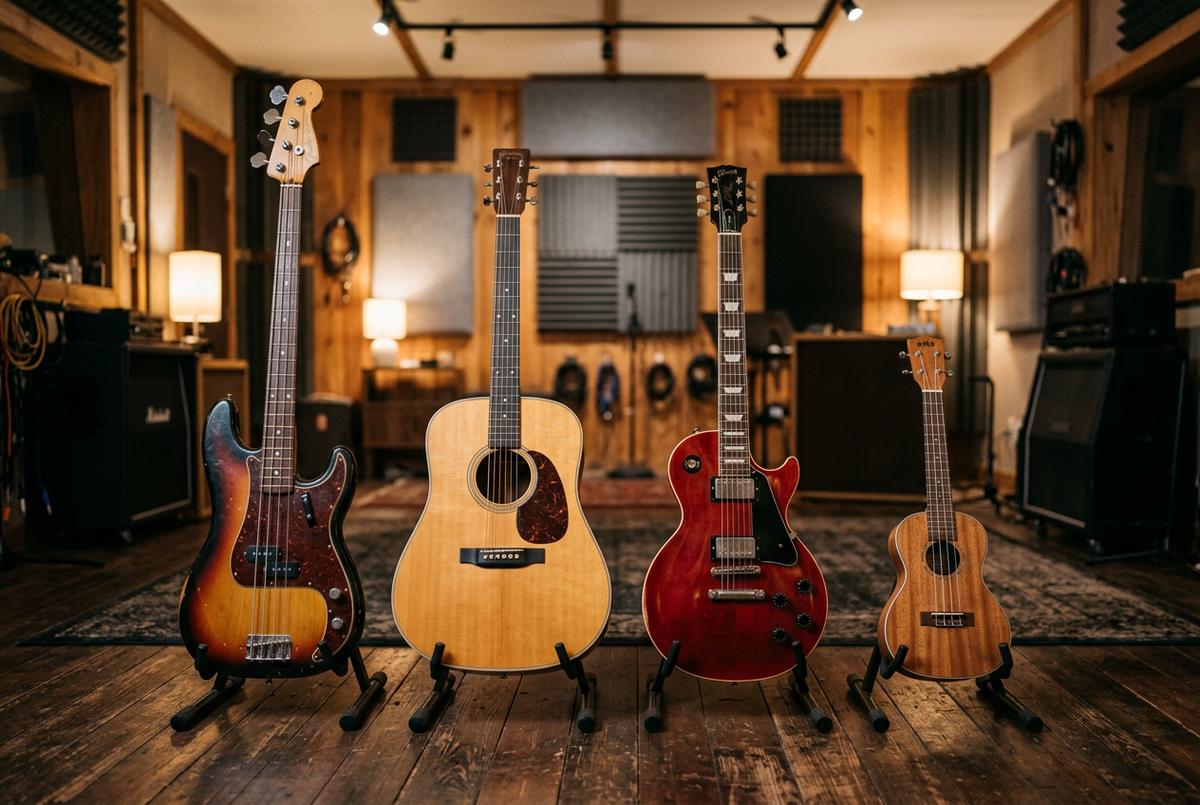
Choosing between guitars, basses, and ukuleles has more to do with the music you want to make, comfort, and how you practice than with a ranking of best and worst.
Perhaps you want to accompany your voice, build the rhythm of a band, or record ideas at home. Maybe you already play and are looking for a different range. This guide brings together the criteria to guide that choice: what each family offers, what details to compare, and what equipment you need around it.
It is the same idea that guides our way of working at Tienda Microfusa: helping you choose with criteria. Before looking at finishes or adding features, you need to understand what they will be used for.
Guitar, bass, or ukulele: start with the role you want to play
All three allow you to create music from day one, but they do not necessarily occupy the same space in a song. Listen to a song you like and try to recognize which part you would like to play.
If you already work with music as a performer or production professional, you probably have many of these criteria clear.
If you follow the chords that accompany the voice, the arpeggios, or the solo melodies, the guitar offers very different paths. If you are drawn to how the pulse and the low notes connect, the bass deserves its own listen. If you are looking for a compact instrument to accompany songs and explore chords and melodies, the ukulele may fit.
These are guidelines, not boundaries. A bass can carry a melody; a guitar can hold the rhythm; a ukulele allows for much more than a simple strum. Choosing by function helps you start without limiting what you can do later.
Our recommendation is concrete: choose three songs you would like to play, identify the instrument that attracts you the most, and think about where you are going to practice. That information guides a purchase better than a list of features without context.
How to choose a guitar: classical, acoustic, or electric
There is no mandatory ladder from Spanish guitar to acoustic and then electric. You can start directly with the family that makes sense for your music. Yamaha's selection guide warns against the idea that every beginner should start with nylon to later move to steel.
Open the reel on Instagram if the player is not displayed.
Classical or Spanish guitar: the feel of nylon
The classical guitar uses nylon strings or equivalent materials, with frets usually wound. It is a common choice for classical repertoire and also for accompaniments and other ways of playing that seek that string response.
Its necks usually offer more separation between strings than many steel models. That space can facilitate certain fingerings, but it does not guarantee comfort for every hand. If the neck is wide for you, some positions may require more opening.
When comparing Spanish guitars, think about how you hold the body, how your hand reaches the first positions, and how much effort you need to press a clean note. The material of the strings matters; the setup and posture, too.
Classical and flamenco are also not exact synonyms. Although they share the nylon string family, it is advisable to choose according to the repertoire and the response of the model, not just because both are advertised as Spanish.
Steel acoustic guitar: accompaniment and attack response
In common store language, we talk about acoustic to refer to the steel-string guitar, although a classical one also produces sound acoustically. Steel provides a different character than nylon and is common in pop, folk, country, and many vocal accompaniments.
The size of the box influences how the instrument is placed against the body. A large guitar may force you to lift your arm higher; a more compact one may be easier to handle. None of those sensations can be deduced solely from a photograph.
Before choosing, decide if you are going to strum, play with your fingers, accompany someone else, or record. You are not just looking for an attractive sound on an isolated note: you are looking for a response that works with your way of playing.

Gibson 50s LG-2 Antique Natural.
Electric guitar: the instrument and its listening system
If you want to play electric, you can start with electric. Its sound is part of a chain that includes the instrument, amplification or processing, and the way you listen to yourself.
It is advisable to compare the comfort of the neck, the weight, the access to the controls, and the possibilities of its pickups. Do not just stick to how many it has: what matters is what you can do with each position and how it responds in the equipment you will use.
The bridge also deserves attention. If it incorporates a tremolo arm, ask about its operation and the string changing and adjustment procedure. If you plan to alternate tunings, mention it before deciding: not all systems behave the same when changing tension.
To practice without a conventional amplifier, you need a compatible solution that processes and allows you to listen to the signal, such as a unit with a headphone output or an interface and software. Headphones alone do not replace that chain.

Fender Nocaster 1951 American Vintage II 75 Anniversary.
Electroacoustic: an output does not change the string family
An electroacoustic guitar allows you to capture its sound through a built-in system to connect it to other equipment. It can be a useful solution for live performance or recording, but the electronics do not turn a nylon guitar into a steel one.
When looking at electroacoustic guitars, check the type of strings, the system's power supply, and the available controls. Also think about the destination of the signal: it is not the same to enter a mixing board, an interface, or an amplifier designed for that use.

How to choose a bass: range, scale, and comfort
The bass deserves to be chosen for what you want to do with it, not as a guitar with fewer strings. Its relationship with rhythm, the duration of the notes, and harmony changes the way you build a musical part.
To start, pay as much attention to holding and muting the notes as to finding them. A simple line can fulfill an important function if it sounds where it should and leaves space for the rest.
Four or five strings: more range does not mean a better choice
The four-string bass is a common reference for getting started. Its standard tuning, from low to high, is E, A, D, and G. It allows you to work a great amount of repertoire without adding more strings to control.
A five-string bass usually incorporates a low B below the E. That range can be useful if your songs call for it, but it adds fingering and muting decisions. The neck width and the separation between strings depend on the model: compare them, do not take them for granted.
In the four-string electric basses you will find a starting point to focus the choice. If you need lower notes, explain what repertoire you want to play before deciding between more strings or a different configuration.
Short or long scale: it matters where the first note is
The scale is the vibrating length of the string. Fender cites 34 inches for long scale and 30 for short scale as common references, although there are other measurements and designs.
A shorter scale brings the frets closer, but comfort does not depend solely on that distance. The position of the neck relative to the body, its profile, the balance of the instrument, and the way you put on the strap also count.
Do not assume that a short-scale bass is exclusively for children or beginners. Nor that a large instrument will fit you just because of your height. The useful question is if you can reach the necessary positions without forcing your posture.
Electronics and controls: understand what you are adjusting
Check what each knob controls and if the circuit needs power. If it takes batteries, confirm how they are replaced and what the manufacturer says about connection and consumption. Do not deduce the operation of a bass solely by its appearance.
When comparing sounds, maintain a similar listening level. Our proposal is to assess if the instrument offers the definition and the adjustment range you need, not if a configuration sounds louder at first contact.
How to choose a ukulele: size, space, and tuning
The ukulele is an instrument with its own technique and repertoire. Its compact format can make it easier to have it at hand, but it does not turn it into a toy or a mandatory step before the guitar.
The main decision is usually between soprano, concert, tenor, and baritone. The name does not indicate a level: a soprano is not necessarily for beginners and a tenor does not require previous experience.
Soprano: compact and with close frets
The soprano is the smallest of these four common formats. Its short scale leaves less space between frets, something that can be comfortable or narrow depending on your hand and the positions you play.
If you are looking for ease of transport, compare soprano ukuleles, but do not decide solely by their dimensions. Check that you can place the chords you need without crowding the fingers or tensing the wrist.
Concert and tenor: other proportions for playing
The concert offers a larger scale than the soprano; the tenor expands that space again. Kala's guides describe these differences as a factor of comfort and access to the fretboard, not as a quality hierarchy.
Concert ukuleles allow you to explore an intermediate format. In the tenor family you will find more space to compare positions and melodic work. The size guides, but the construction and the strings also intervene in the result.

Fender Montecito tenor Shaded Edge Burst.
Baritone: attention to tuning
The usual tuning of soprano, concert, and tenor is G, C, E, and A. The baritone is usually tuned D, G, B, and E, like the four highest strings of the guitar.
That difference matters when choosing learning materials: the same finger posture does not necessarily produce the same chord in both tunings. If you come from guitar, the baritone can offer you familiar references; if you follow a method for standard ukulele, you will have to check its compatibility.
In the collection of tenor and baritone ukuleles, look at the sheet of each instrument. Sharing a collection does not mean sharing tuning.
To continue with the practical part, you can consult our basic ukulele guide: chords, notes, and tuning. Identify first the type of ukulele and the tuning for which it is strung.
Comfort is not summarized in the size of your hands
The neck width, its thickness, the distance between strings, and the scale describe different things. Two instruments that seem similar can place your hands and arms in different ways.
The action also matters, that is, the height of the strings relative to the frets. An inadequate height can make strumming difficult, but lowering it without criteria does not solve all problems: the setup must respond to the instrument and how you play.
If you can compare an instrument, start with your usual posture. Hold it sitting and, if you are going to play like that, standing with a strap. Go through the positions you will use, check if you reach the controls, and pay attention to any discomfort.
Do not turn pain into a test of commitment. If you have to force the posture continuously, review technique, placement, and setup before taking for granted that you only need practice. For a distance purchase, check the dimensions and profile of the model and explain what instrument you use now or what is uncomfortable for you.
What equipment you need to practice, rehearse, and record
The useful budget is that of the set you are going to use, not just the instrument. Buying an electric or a bass without planning how to listen to yourself can leave you with half a solution; buying accessories without a clear function can spend the margin you needed for something essential.
To play at home
A classical, an acoustic, or an acoustic ukulele allows you to practice without amplification. Add a tuner, proper protection to transport it, and the accessories that your way of playing requires.
In electric or bass, decide between amplification, a headphone solution, or a computer-based chain. Check the connections and the compatibility of the set before buying separately. To play with other people, choose the listening system according to the context, not just according to a power figure.

To record directly
When connecting an electric guitar or a bass to an interface, check that it has a proper instrument input, usually identified as Instrument or Hi-Z. That the connector accepts a jack is not enough to confirm its function.
A basic chain can be instrument, interface, software, and headphones or monitors. If you use amplifier simulation, also check how you are going to monitor it and the response when playing. Before adding effects, make sure the signal enters without saturating.
To record the acoustic sound of a guitar or a ukulele you can use a microphone and a proper interface. If the instrument has built-in pickup, you have another connection route, but you should not expect that both capture exactly the same.
To play live
Think about the whole route: instrument, power if it needs it, cabling, processing, input to the sound system, and listening on stage. Having an output on the instrument does not confirm that you can connect it to any equipment with any cable.
When asking for advice, describe if you will act alone or with a band, if there will be a sound system, and what equipment you already have. These are more useful data than looking for a solution supposedly valid for any scenario.
How to distribute the budget without buying twice
Before comparing finishes or extras, write down what you need to be able to play from day one. Then separate the essential from what you can add later.
For an electric or a bass, reserve margin to listen to yourself, connect, and transport the instrument. For an acoustic or a ukulele, assess protection, tuning, and compatible replacement strings. Check what each option really includes: not all instruments come with a case or accessories.
The most useful improvement depends on your starting point. If your current equipment allows you to make the music you want, you may first need to address setup, monitoring, or a more comfortable way to practice. Not every difficulty is solved by buying another instrument.
If you are looking to expand your equipment, identify what you are missing: a different range, another response, less weight, or a connection for live performance. This way, you compare concrete possibilities, not prices as if they described quality or suitability on their own.
Strings, tuning, and care: what is good to have clear
Choose the strings for the intended instrument and tuning. Do not put steel strings on a guitar designed for nylon: Yamaha and Taylor warn of the risk of damage from the additional load. Just because a low string has metal winding does not mean it is suitable for a steel-string acoustic set.
On the ukulele, check the size and tuning before buying a set. On guitar and bass, a change in gauge or tuning may require checking the setup. If you do not have experience with that work, ask for guidance before handling elements you are unfamiliar with.
Protect the instrument from direct heat, sudden changes, and extreme humidity conditions. Follow the manufacturer's instructions for preservation and cleaning; do not apply household products or fretboard treatments without checking that they are suitable for that material and finish.
Tune before playing and recheck during the session when necessary. The tuner is a reference for listening and working consistently, not an accessory reserved for beginners.
Frequently asked questions about guitars, basses, and ukuleles
Do I have to learn classical guitar before playing electric?
No. You can start directly with an electric guitar if that is the sound and repertoire that interest you. The important thing is to choose a comfortable instrument and plan an appropriate way to hear yourself. Classical is not a mandatory stage, nor nylon a level prior to steel: they are choices with different characteristics.
Can you learn bass without knowing how to play guitar?
Yes. You can learn bass from scratch. Having played guitar can provide references, but it is not a requirement. It is good to work from the beginning on timing, note duration, string muting, and the relationship with harmony. Sharing some note names does not make the technique of both instruments the same.
Is the ukulele easier than the guitar?
Some initial ukulele chords require few positions, and its compact format can facilitate certain beginnings. That does not guarantee that it is more comfortable for anyone or easier to master. If what you want to play sounds like guitar, you do not need to choose another instrument first to earn your way to the one you are really interested in.
Are all ukuleles tuned the same?
No. Soprano, concert, and tenor usually use G, C, E, and A, while the baritone is usually tuned to D, G, B, and E. There are also alternative configurations, such as low G on instruments prepared for it. Before following a chord chart or changing strings, confirm the specific configuration of your ukulele.
Can I play electric guitar or bass with headphones without an amplifier?
Yes, if you use a compatible device that receives the instrument signal and has a headphone output, or an interface with the necessary equipment and software. It is not enough to connect headphones to the usual instrument output. Check what each solution needs to work and what it includes before choosing it.
Choose with your music in mind
To guide your choice, tell us what you want to play, what equipment you have, and where you are going to use it. If you know your total budget or if there is something that is uncomfortable for you on your current instrument, add it: it will help us focus the options.
You can start by exploring our selection of guitars, basses, amplification, and effects. There is no need to look for the instrument with the most features, but the one that makes sense in your way of making music.
Technical reference sources: Yamaha guides on choosing an acoustic guitar and string compatibility; Fender guide for choosing a bass; Kala guides on ukulele sizes and tuning; Guitarristas.info guidance on interfaces for recording guitar. The selection recommendations of this guide are Microfusa's editorial criteria, not an independent test of specific models.