

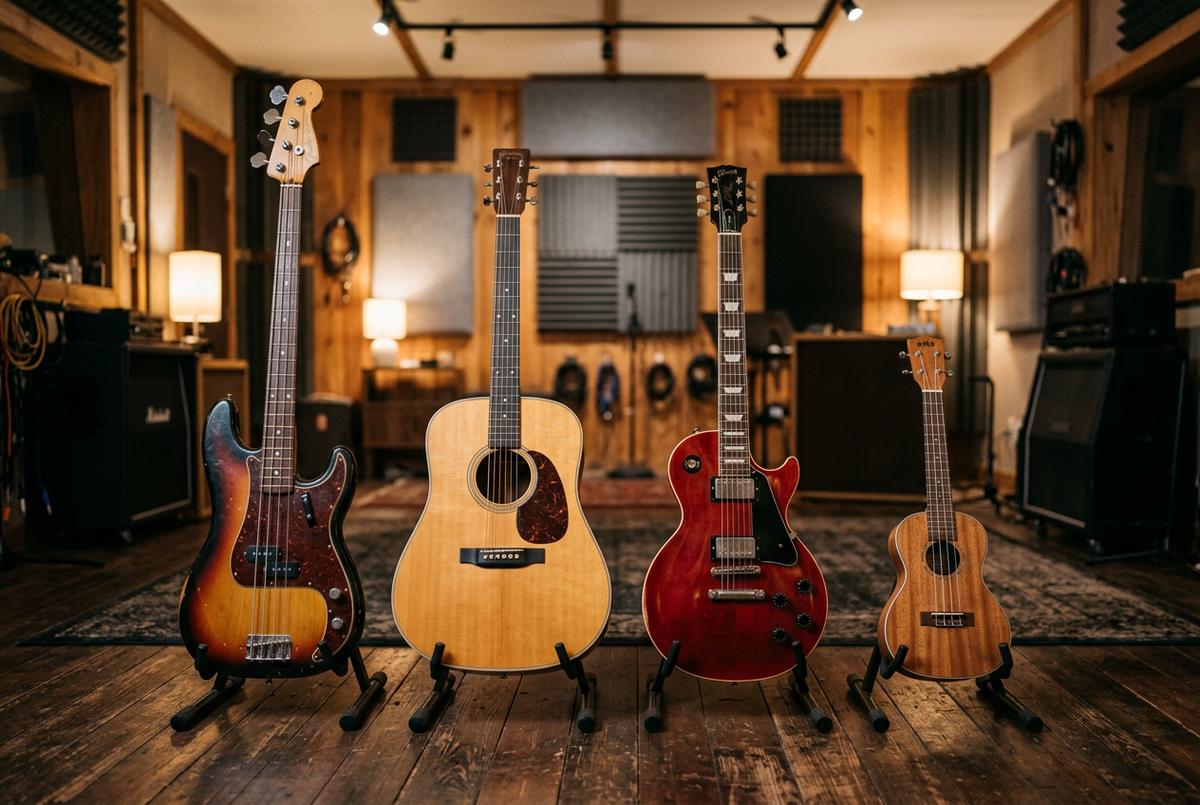
A guitar, a bass, and a ukulele can all be heard in the same song, each doing something very different. That’s where the choice between guitars, basses, and ukuleles begins: in the part of the song you want to play, the feel you’re looking for, and where you’re going to practice.
Maybe you want to accompany your voice, hold down the groove for a band, or record ideas at home. Maybe you’ve been playing for years and are looking for another family of stringed instruments to expand your range. This guide brings together the criteria we use to help you choose at Tienda Microfusa: what each instrument offers, which measurements to compare, and what equipment you’ll need around it.
If you already know your setup preferences by heart, here you’ll find a clear overview. And, while you’re at it, you’ll have a guide you can pass on to anyone asking about their first instrument.
And if you’re thinking about getting your first guitar, you can start with our Black Friday guitar deals and use this guide to help you choose wisely.
Guitar, bass, or ukulele: what part of the song do you want to play?
Put on a song you like and listen to it with purpose. If you find yourself drawn to the chords supporting the voice, the riff, or the solo, you’re in guitar territory. If you find yourself following the kick drum and the low notes driving the song, the bass is calling you. If you imagine accompanying songs with something that fits in your backpack, the ukulele has a lot to say.
These are starting points, not boundaries. There are bassists who carry the melody, guitarists who live in the rhythm, and ukuleles that go far beyond strumming.
An exercise that works: write down three songs you’d like to play, mark the instrument that appeals to you most for each one, and think about where you’re going to practice. At home, in a rehearsal studio, or on stage. With that in mind, any comparison of models starts to make sense.
How to choose a guitar: classical, acoustic, or electric
You can start directly with the guitar that sounds like your music. The idea that every beginner should start with nylon is a widely held myth: the choice depends on the repertoire and the sound you’re looking for, not on a ladder of levels.
Open the reel on Instagram if the player doesn’t appear.
Spanish or classical guitar: the feel of nylon
Nylon strings have a soft attack and a warm sound that supports the voice without overpowering it. The wound bass strings provide the low end.
The neck is usually wider and has more space between the strings than many steel-string guitars. That space makes some fingerings easier while requiring more openness in others: it depends on your hand. When comparing, pay attention to how you support the body, how you reach the first positions, and how much effort it takes to play a clean note.
Classical and flamenco guitars belong to the same family, but each has its own character. Flamenco guitars usually offer a drier, more percussive attack and lower action for strumming and tapping. You can explore the entire family in Spanish, classical, and flamenco guitars, or go straight to classical guitars and flamenco guitars.
Acoustic guitar: the brightness of steel
In our store, we call steel-string guitars acoustic, even though classical guitars also sound unplugged. Steel provides brightness, projection, and a strumming style with punch. That’s why it’s found in so much pop, folk, country, and singer-songwriter music.
The body changes the physical experience. Dreadnoughts and jumbos usually have larger bodies and may require you to lift your arm a bit higher. Auditorium and parlor guitars are usually more compact; the specific dimensions of the model and your posture will determine how comfortable it is.
Before choosing, think about your right hand: do you strum with a pick, play with your fingers, accompany someone, or record? The answer you’re looking for is the one that works with your playing style. You’ll find the entire family in acoustic guitars. And if you’re tempted by the natural chorus of a 12-string, it has its own section in 12-string acoustics.

Gibson 50s LG-2 Antique Natural.
Electric guitar: the instrument and its signal chain
If electric is your thing, start with an electric guitar. Its sound comes from the whole setup: guitar, pickups, amplifier or processor, and the way you listen to yourself.
Compare neck comfort, weight, and access to the controls. With pickups, it’s useful to know what each selector position does. Single-coil pickups usually sound brighter and more defined; humbuckers sound fuller and have less hum.
Shapes also tell their own story: Stratocasters, Telecasters, single-cuts, or semi-hollows. And if you’ve been debating for years how much the wood matters in an electric guitar, we’re not going to reopen that debate here: leave it for the rehearsal studio bar.
The bridge deserves attention. If it has a tremolo arm, ask how it’s adjusted and how the strings are changed. If you alternate tunings, mention it before deciding, because not all systems respond the same way to changes in tension. For small hands or a more compact feel, there are short-scale electric guitars.
To practice without a conventional amplifier, you need something that processes the signal and has a headphone output: a multi-effects pedal with that output or an interface with software. Headphones alone don’t complete the chain. If you’re starting from scratch, an electric guitar and amplifier pack solves the whole setup at once. All the options are in electric guitars.

Fender Nocaster 1951 American Vintage II 75th Anniversary.
Electroacoustic: the same guitar, ready to plug in
An electroacoustic guitar adds a pickup system so you can connect it to other equipment. It’s a great ally for live performances and recording, and the electronics don’t change the string family: an electrified classical guitar is still nylon.
Check the type of strings, the system’s power supply, and the controls. Also think about where the signal will go: a mixing board, an interface, or an acoustic amplifier. You’ll find them in electroacoustic guitars and electrified classical guitars.

How to choose a bass: range, scale, and comfort
The bass unites rhythm and harmony. It decides when each low note begins and ends, and that’s noticeable throughout the song. Anyone who has ever rehearsed with a band knows it: when the bass goes silent, the song loses its foundation.
That’s why it deserves to be chosen as an instrument in its own right. From day one, it works both on cutting off the notes and finding them: a simple line, in the right place, supports an entire song.
Four or five strings: the range your songs require
The four-string bass, tuned E, A, D, and G from low to high, covers a lot of repertoire with just a few strings to manage. It’s the usual starting point, and you’ll find it in 4-string electric basses.
The five-string usually adds a low B below the E. It’s a common option if your songs go below that B, and it adds decisions about fingering and muting. The neck width and the space between the strings change from one model to another: compare them in the product sheet.
And if you’re already looking for a six-string or a fretless to slide the notes your way, they also have their place in the catalog.
Short or long scale: where the first note sits
Scale is the vibrating length of the string. The most common reference for long scale is 34 inches, and for short scale, 30; other measurements and designs exist.
A shorter scale brings the frets closer together and, while maintaining the same type of string, gauge, and tuning, reduces the tension. The position of the neck relative to the body, its profile, the balance when hanging from the strap, and the weight also count.
Short scale is also chosen by musicians with years of experience for its feel and response. The useful question is another: can you reach the positions you need without straining your shoulder or wrist?
Electronics and controls: understand what you’re adjusting
Check what each control does and if the circuit needs power. If it takes batteries, check how they’re replaced and what the manufacturer indicates.
When comparing sounds, keep a similar volume between basses. What you’re looking for is definition and room to adjust for your music, and the one that sounds louder at first contact usually wins on volume, not on sound. The entire catalog is in electric bass.
How to choose a ukulele: size, space, and tuning
The ukulele has its own technique, repertoire, and players. Many formats are easy to carry and stay close at hand on the sofa, and that invites you to play them more often. It’s a complete instrument, not a prelude to the guitar.
The main decision is between soprano, concert, tenor, and baritone. Each size changes the comfort and the sound, not the quality, and they all work for any level. Explore the entire family in ukulele.
Soprano: compact and with closely spaced frets
The soprano is the smallest of the four, with a sound that is usually bright and light. Its short scale brings the frets together: for some hands, it’s agile, and for others, cramped.
If you’re looking for an easy-to-carry instrument, start with soprano ukuleles. Check that you can place the chords you need without crowding your fingers or tensing your wrist.
Concert and tenor: more space for your fingers
The concert ukulele lengthens the soprano’s scale and usually gains body in the mids. The tenor expands the space between frets once again, something that is appreciated in lead playing and melodic work.
Concert ukuleles are a good intermediate format for comparison. The size provides guidance, and the construction and strings finish defining the result.

Fender Montecito tenor Shaded Edge Burst.
Baritone: pay attention to the tuning
Soprano, concert, and tenor are usually tuned to G, C, E, and A. The baritone is usually tuned to D, G, B, and E, like the four highest strings of the guitar.
That difference matters when choosing a method: the same finger position gives different chords in each tuning. If you come from the guitar, the baritone will feel familiar from the first chord. If you follow a standard ukulele method, check that it fits your instrument.
Tenor and baritone share a section in tenor and baritone ukuleles, so pay attention to the product sheet for each one. And for the practical part, you have our basic ukulele guide: chords, notes, and tuning.
Comfort goes beyond the size of your hands
Neck width, thickness, string spacing, and scale describe different things. Two instruments that look similar in a photo can position your hands and arms very differently.
Action also counts, the height of the strings above the frets. Poorly adjusted action makes strumming difficult, and lowering it without criteria brings buzzing. Good adjustment responds to the instrument and your way of playing. Anyone who already has their list memorized (height, neck relief, intonation) knows that a good setup changes an instrument completely.
If you can try it, start with your usual posture: sitting down and, if you’ll play that way, standing with a strap. Go through the positions you’ll use, check that you can reach the controls, and listen to your body. If you notice that you’re constantly straining, check your technique, placement, and setup before blaming a lack of practice.
If you’re buying from afar, check the measurements and neck profile in the product sheet. Tell us what instrument you use now and what feels uncomfortable: with that reference, we can guide you better.
What equipment you need to practice, rehearse, and record
The useful budget is for the whole setup you’re going to use. An electric guitar or a bass without a way to hear yourself is only half a solution.
For playing at home
A classical, acoustic, or ukulele sounds without amplification. Add a tuner, a case or hard case to move it, and the accessories your playing style requires. For the ukulele, check the specific cases.
For electric guitar or bass, choose between a guitar amplifier, bass amplifier, a headphone solution, or a chain with a computer. Check connections and compatibility before buying separately. To play with more people, choose according to the context and not just by the power rating.

For recording
If you connect an electric guitar or bass to an interface, check that it has an instrument input, normally marked as Instrument or Hi-Z. The fact that the connector accepts a jack does not confirm its function.
A basic chain is instrument, interface, software, and headphones or monitors. If you use an amplifier simulator, check the monitoring and the response when playing. Before adding effects, make sure the signal enters clean and without saturating.
To record the acoustic sound of a guitar or ukulele, use a microphone and a suitable interface. If the instrument has a pickup, you have another way of connecting, with a different character from the microphone.
For live performances
Think about the whole path: instrument, power supply if it needs it, cables, guitar pedals and effects or bass, input to the sound system, and monitoring on stage. Having an output on the instrument does not guarantee that it will connect to any equipment and any cable.
When you ask us for advice, tell us if you’ll play alone or with a band, if there will be a sound system, and what equipment you have. With that data, the recommendation will fit your scenario.
How to allocate the budget without buying twice
Before comparing finishes or extras, write down what you need to play from day one. Then separate the essentials from what can come later.
For an electric guitar or bass, leave room to hear yourself, connect, and transport the instrument. For an acoustic guitar or ukulele, think about protection, tuning, and spare strings. Check the product page to see what each option includes, because not all instruments come with a case or accessories.
If you already play, the most useful upgrade depends on your starting point. Sometimes what your setup needs is an adjustment, better monitoring, or a more comfortable way to practice. If you're looking to expand, identify what you're missing: another range, another response, less weight, or a connection for live performance.
Check out our Black Friday guitar deals. Compare the options with your music and your budget in mind: the best purchase is the one that suits you.

Strings, tuning, and care
Choose the strings according to the instrument and the intended tuning. Never put steel strings on a guitar designed for nylon: the two types are not interchangeable, and the additional tension of steel can damage a guitar designed for nylon.
For the ukulele, check the size and tuning before buying a set. For guitar and bass, a change in gauge or tuning may require checking the setup. If you have never done it, ask for guidance before touching the truss rod or nut.
Humidity is one of the factors that most affects the health of a guitar. Protect the instrument from direct heat, sudden changes, and very dry or very humid environments. To clean, follow the manufacturer's instructions and use products designed for that finish and that wood.
Tune before playing and check again during the session. A tuner is just as useful for someone starting out as it is for someone who has been playing for twenty years walking onto stages.
Frequently asked questions about guitars, basses, and ukuleles
Can you learn bass without knowing how to play guitar?
Yes, you can start with the bass from scratch. Having played guitar provides references, but it is not a requirement. From the beginning, it is useful to work on timing, note duration, string muting, and the relationship with harmony. Both instruments share note names, and each has its own technique and its own role in the band.
Is the ukulele easier than the guitar?
It depends on what you want to play. Some initial ukulele chords are formed with a few fingers, and its compact size makes the first steps easier. That does not make it more comfortable for everyone or easier to master. If the music that moves you sounds like guitar, start directly with guitar: there is no need to earn your way with another instrument.
What size guitar does a child need?
Children's guitars are sold in sizes such as 1/4, 1/2, and 3/4. Those fractions are size names, not exact proportions, and each manufacturer adjusts their measurements. More than age, height and arm reach matter: it must reach the first positions without straining the shoulder or hunching over. You will find those sizes in Spanish guitars for children and in acoustic guitars for children.
Are there guitars and basses for left-handed people?
Yes. Left-handed models are designed to be played in the opposite orientation to right-handed ones, with the string arrangement and components adapted to it. Converting a right-handed instrument is not always feasible or solved just by reversing the strings: it may require replacing the nut, adapting the bridge, and checking the position of controls and other elements. Consult a professional first. You have options in electric guitars for left-handed people, acoustic guitars for left-handed people, and basses for left-handed people.