

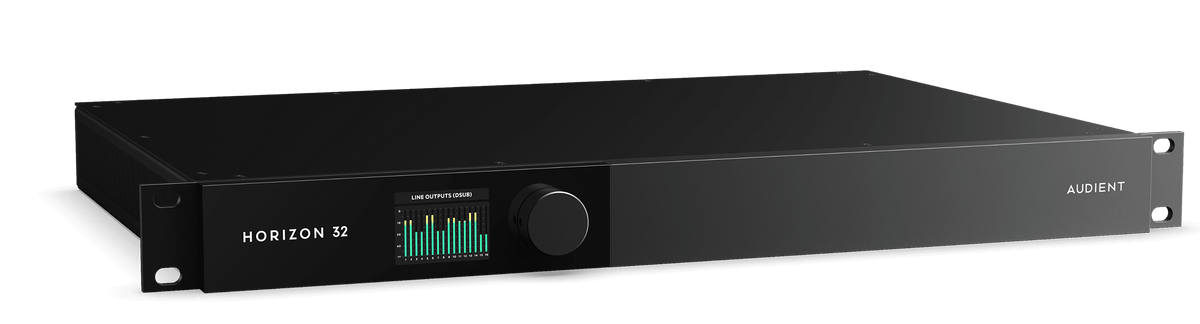
More channels, integration with analog hardware, and a DAW-centric workflow. The new Audient Horizon series brings together three Thunderbolt 3 audio interfaces designed for different professional studio needs: Horizon 8P, Horizon 16, and Horizon 32.
The range combines 32-bit conversion at up to 192 kHz with a scalable architecture. From recording multiple sources with built-in preamplifiers to connecting a console or rack of external processors, each model offers a different way to build the hub of your studio.
A common platform for working with native plugins
All three Horizon interfaces are designed to take advantage of the power of modern computers and make recording and monitoring easier through native plugins. According to the specifications provided by the brand, the series achieves a dynamic range of 133 dB and round-trip latency of up to 0.99 ms. Actual latency will depend on the system configuration, the session, and the plugins used.
Shared connectivity includes dual ADAT I/O, with up to 16 channels of digital expansion, Word Clock I/O via BNC, and selectable reference levels of +18 dBu and +24 dBu. The number of available digital channels depends on the sample rate used.
Horizon Control software centralizes routing, monitoring, and metering through a virtual patch bay, allowing you to organize the studio's connections from a single application.
Horizon 8P: eight preamps to put recording first

If your priority is recording vocals, drums, or instruments with multiple simultaneous sources, Horizon 8P is the recording-oriented model in the family. It offers 24 inputs and 32 outputs and includes eight microphone preamplifiers based on the Audient ASP8024-HE console design.
Its preamps provide 75 dB of gain and variable impedance with three selectable settings. This is complemented by Smartgain and digital settings recall, features designed to streamline session setup.
It also includes eight line I/O channels via DB25, two JFET instrument inputs, two monitor outputs, and two headphone outputs. From Horizon Control, you can create four independent headphone mixes, with custom monitoring options and built-in auxiliary reverb.
Its approach is particularly interesting for studios looking to combine preamplification, line connections, and monitoring control in a single rack unit.
Check out the Audient Horizon 8P at microFusa
Horizon 16: the meeting point between your DAW and analog hardware
Horizon 16 is designed for hybrid studios. Its 34 inputs and 34 outputs include 16 line inputs and 16 line outputs distributed across four DB25 connectors, a configuration that allows you to keep a rack of compressors, equalizers, preamps, and other external processors connected.
The concept is clear: integrate analog equipment into the DAW workflow without having to reorganize the connections for every session. It also includes dedicated stereo inputs for the mix bus, allowing you to record the final mix without using the main inputs, and independent stereo outputs for monitors.
It is an option to consider if you already have external preamplifiers and want the interface to act as the conversion and connection hub of your studio.
Check out the Audient Horizon 16 at microFusa
Horizon 32: more connections for larger studios

For installations that need to manage more channels, Horizon 32 offers 50 inputs and 50 outputs. Its analog connectivity includes 32 line inputs and 32 line outputs via eight DB25 connectors, all in a single 1U rack unit.
This capacity allows you to connect a console or a large set of external processors to the DAW. Like Horizon 16, it features stereo inputs dedicated to the mix bus and independent stereo outputs for monitoring.
Due to its number of connections, it is the model in the family most geared toward commercial studios, large project studios, and hybrid systems with extensive analog hardware.
Check out the Audient Horizon 32 at microFusa
A system that can grow with your studio
The Horizon architecture allows you to daisy-chain up to four units and achieve a maximum of 200 inputs and 200 outputs, depending on the combination of models and the configuration used. It is a way to create a scalable installation as recording or mixing needs increase.
All three models share an all-metal 1U chassis and are designed to work with macOS at sample rates of up to 192 kHz.
Which Audient Horizon fits your workflow?
The choice depends mainly on what you need to connect. Horizon 8P focuses on recording with eight built-in preamps. Horizon 16 offers a line configuration for hybrid studios with external hardware. Horizon 32 expands on that idea for installations requiring a greater number of analog connections.
At microFusa, we will help you determine which model works best with your preamplifiers, processors, and monitoring system, so that your studio expansion matches your way of working.