

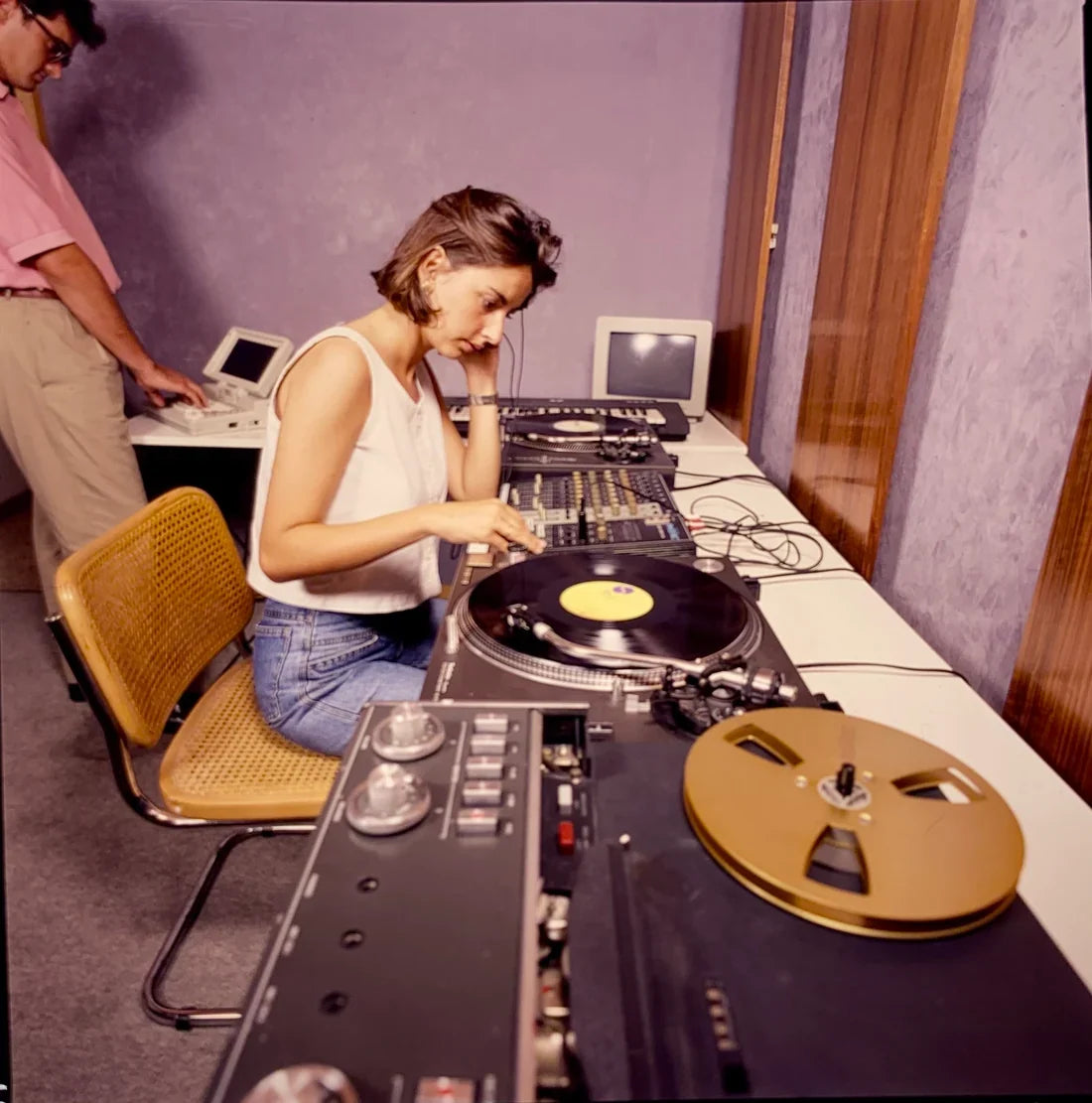
Almost everyone who makes music recognizes that moment: what was playing in your head starts playing outside. A voice that finally finds its place in the mix, a guitar recorded with the sound you were looking for, a beat that breathes, a session where the track responds.
The Microfusa School exists to accompany that moment and all those that come after. Since 1987, we have been a training center for sound, music production, and DJing, with locations in Barcelona and Madrid and an online campus. Every year, hundreds of people pass through here with something to say through sound.
On this page, we tell you where we come from, how we teach, and what you can study.
What is the Microfusa School?
It is the training area of the Microfusa Group, the ecosystem that also includes the stores in Barcelona and Madrid and the online store. The school and stores share an origin and a way of understanding music, but here we are only talking about the school: a center specializing in a specific field: how today's music is created, recorded, mixed, spun, and brought to the public.
Between Barcelona and Madrid, we have more than 1,400 m² of recording studios, DJ booths, computer classrooms, and common spaces. To that is added online training, which functions as another center.
Very different profiles arrive at the school: those who want to dedicate themselves to music from the start, those who already play or sing and need to understand the technology, those who work in the sector and are looking to specialize, and those who decide to take seriously what they had been doing in their bedroom for years. What they share is not their starting level. It is the desire to do it better.
From sound laboratory to school: our history
In 1987, two young musicians, Gego Revuelta and Ignasi Benavent, set up what they then called a sound laboratory in Barcelona: a space to experiment with sound and music and share knowledge and equipment. The name was already a statement of intent: micro, from microcomputer, and fusa, the musical figure that lasts a thirty-second of a whole note.
At first, the project was closely linked to the Taller de Músics, whose students found training in new technologies applied to music at Microfusa. In 1989, already led by Ignasi Benavent, the project began to define itself as a school of sound and musical computing, which is what technology for creation and production was called back then.
A detail that usually surprises: the store was born inside the school, not the other way around. The students needed the equipment they were learning with, and in the early 90s, the first Microfusa store opened, sharing space with the classrooms.
The 90s: growing and going online
- Early 90s. Three new partners join (David Vives, Jordi Guber, and Marià Sol), and the school moves to larger premises.
- 1997. Microfusa's first website.
The 2000s: online, Madrid, and the industry
- 2003. Move to the current Barcelona location on Ronda del Guinardó.
- 2004. First virtual campus. Microfusa begins to train online when almost no one in the sector was doing it.
- 2005. The AES (Audio Engineering Society) recognizes Microfusa as a Student Section, the first school in Spain with this distinction. That same year, the Music Production Master's begins, with speakers such as Phil Manzanera, and the school has its own stand at SonarPro.
- 2006. The Madrid school and store open, and Microfusa becomes an Apple-authorized training center (Logic Pro and Final Cut Pro).
- 2007. Twenty years. They are celebrated with the Microfusa Festival at Razzmatazz (Barcelona) and Caracol (Madrid) and with 8707, an album, in CD format, compiling artists who had passed through the house.
- Late 2000s. Microfusa collaborates with Sónar: it advises on the SonarPro format and sets up a DJ workshop for children at SonarKids (MACBA), with six booths.
The 2010s: academic alliances
- 2011. Microfusa hosts the first Ableton instructor certification program in Spain in Barcelona. Together with the Universitat Autònoma de Barcelona (UAB), it launches a master's and a postgraduate degree in Sound Production and Audiovisual Broadcasting, a collaboration that has since ended.
- 2014. The collaboration with Solent University (Southampton) begins, with an exchange between Diploma students and British students. It is the seed of the current Bachelor pathway. We keep a memory of those first meetings in the chronicle of the visit of the Solent University students to Microfusa in 2014, in which they shared projects and mixing sessions with our students.
- 2015. Together with the Superior School of Music Jam Session, it offers the Higher Music Degree, specializing in Sonology. Currently, this course is no longer in effect.
-
2016–2019. The Madrid school goes through various spaces in Madrid until it permanently settles in the new facilities in Arganzuela in 2019.
The 2020s: specializing and sharing the stage
- The University of Winchester joins as the second British university in the Bachelor pathway.
- The specialization master's degrees (artistic, technological, and music business) arrive, along with mFLive concerts and the Microfusa Festival, where students share the lineup with artists.
- The alliance with the Taller de Músics for the Songwriting Degree was already announced on our blog in 2022. Decades after its beginnings, the school once again shares a project with the center where it started.
How we teach: the pillars of the school
1. You learn by doing
Theory is there, but it serves practice. Guided classes are held in computer classrooms with one computer per student, using the same software used in the studios, and much of the training takes place in studios and booths, not in front of a whiteboard.
2. Time outside class also counts
A mix doesn't come out well the first or fifth time. That is why the classrooms and studios are made available to students to practice outside of hours, and in the DJ courses, there is a booth reserved for them. That extra time is where what has been seen in class is solidified.
3. Faculty who work in what they teach
Those who teach you how to sound design a live show or mix a voice also do it outside the classroom. You can meet the team and their career path on the faculty page.
4. Production, sound, and DJing do not live separately
Today, those who spin also produce, and those who produce record and mix. Ignasi Benavent summarized it in an interview with Emprendedores magazine (2021) as "the hybridization between production, sound engineer, and disc jockeys". The long programs are built on that idea: understanding the entire chain, even if you later specialize in one part.
5. In-person and online, connected
In-person courses are supported by the virtual campus: theoretical content is available on any device, and that is where tracking, forums, and part of the group work take place. Time in the classroom is dedicated to what can only be done in the classroom.
6. The industry enters the classroom
Dani Val, recording and mixing engineer at Estudio Medusa, has explained to our students how he records voices for artists like Nathy Peluso or Bizarrap. Ainhoa Widder, from Clipper's Music Group, has told them what a talent agency really does. Genís Pena has taught them how Gallery Sessions is set up inside (blog chronicle). And already in 2005, Phil Manzanera was a speaker at the Music Production Master's.
The relationship also goes the other way. In the Urban Concert Cycle, students share the stage with local artists (Barcelona and Madrid), and when an opportunity for internships or collaboration with a company in the sector appears, the school makes it happen.
What can you study at Microfusa?
The offer is organized into six lines. Each will have its own guide on this blog; here is the map.
| Line | What you work on | Formats | Where |
|---|---|---|---|
| Music Production | Creation, arrangement, recording, mixing, and artistic project | 2-year Diploma, shorter courses, and specialization master's degrees (artistic, technological, and music business) | Barcelona, Madrid, and online |
| Sound | Recording and mixing, live sound design, audio post-production, mastering | In-person and online courses | Barcelona, Madrid, and online |
| DJ | Mixing technique, set preparation, track creation, VJ | In-person, online courses, and introductory video course | Barcelona, Madrid, and online |
| Music Business | Industry, career management, music marketing | Courses and master's | Barcelona and Madrid |
| Higher Degrees | Third university year in the United Kingdom after the Diploma | British Bachelor (BA or BSc Hons) with Solent University or University of Winchester | Access from Barcelona, Madrid, or online |
| Specialized Courses | Specific software and certifications | Official Pro Tools (Avid) courses, Ableton Live, private classes | Barcelona and Madrid |
The longest pathway starts with the Music Production Diploma: a first year of creative and technical foundations of digital production, and a second of advanced techniques, professional sound, studio projects, and music business notions. After that, you can specialize with a master's or complete a third year at a British university to obtain a degree (Bachelor). We will explain it in detail in the specific guides.
There are calls at different times of the year (October, January, April, and summer), depending on the course.
Barcelona, Madrid, and online: our centers
Barcelona
Ronda del Guinardó, 65 (Horta-Guinardó), a few minutes from Sant Pau and the Sagrada Família. Open Monday to Friday, from 10:00 to 14:00 and from 16:00 to 19:00. Phone +34 934 353 688. See courses in Barcelona.
Madrid
Paseo de Juan Antonio Vallejo-Nájera Botas, 59 (Arganzuela). Present in the city since 2006 and at this location since 2019. Open Monday to Friday, from 10:00 to 14:00 and from 16:00 to 19:00. Phone +34 917 024 592. See courses in Madrid.
Online
The virtual campus has been operating since 2004. In addition to 100% online courses, it allows you to take the Bachelor pathway in a hybrid format. See online courses.
What you will find at the locations
The two in-person schools share the same layout of spaces:
- Computer classrooms, with one computer per student and the teacher's station connected to projection and studio monitors.
- DJ booths with vinyl turntables, players, tables, controllers, and effects.
- Production studios, with synthesizers, drum machines, preamps, and control surfaces.
- Editing and mastering studios.
- Recording and post-production studios. Three of them are set up with a different configuration each: analog console, digital console, and DAW control surface. This is so you leave having worked in the various situations you will encounter outside.
You can see the detail of each space, with a virtual visit, in Who We Are | Microfusa School.
Before starting: practical information
- You can visit the school in Barcelona or Madrid, or request a virtual appointment, before deciding.
- There are formats for every moment: from a private class to solve a specific question to two or three-year pathways.
- The courses do not include software licenses. As a student, you can request a certificate to access the student licenses offered by many manufacturers.
- In the in-person courses, you do not need your own equipment, except headphones and a USB flash drive.
- The groups are small and the spots are assigned in order of registration.
The school is also experienced outside the classroom
Masterclasses, open sessions, and concerts connect training with the music scene. The Microfusa Festival Barcelona 2025 and the Winter Festival of 2023 at Razzmatazz and Sala Siroco are examples of that activity that goes beyond class hours.
Frequently asked questions
Are the Microfusa School titles official?
The diplomas, certifications, and master's degrees from Microfusa are proprietary titles. If you want a university degree, after the two-year Diploma, you can take a third year at Solent University or the University of Winchester (United Kingdom) and obtain a Bachelor: an official British title, recognized within the European Higher Education Area. Former students have used it to access master's degrees in other European countries. If you are thinking about validating it in Spain, you should know that currently we have not been able to find a way for them to be recognized. This is because the subjects taken at Microfusa cannot be accredited as ECTS, a necessary requirement for the recognition of university degrees in Spain.
Can I visit the school before enrolling?
Yes. You can arrange a visit to the Barcelona or Madrid location to see classrooms and studios and resolve questions with the team. If you cannot travel, or you are interested in an online course, you can also request a virtual appointment. The visit does not commit you to anything.
Is there a deadline to enroll?
There is no closed enrollment period. Since the groups are small, the spots are assigned in order of registration until each group is full. As a reference, many courses that start between late September and early October usually have most of the spots filled by late June. If you are interested in a specific term, it is advisable to reserve in advance.
Can you study at Microfusa remotely?
Yes. Microfusa has offered online training since 2004, with music production, sound, and DJ courses through its virtual campus. The pathway to the Bachelor in Popular Music Production also has a hybrid version, with the first two years online. It is advisable to check on each sheet what equipment requirements the online format asks for.
Do the courses include the software (DAW)?
No. The courses do not include audio program licenses. Once enrolled, you can request a student certificate to buy student licenses, which many manufacturers offer with significant discounts. In the in-person courses, you work in the school's classrooms and studios, with the software already installed.
Come see us (or connect)
The best way to know if the school fits you is to see it: the studios, the booths, the people who are learning right now. Schedule your visit, in-person or virtual and we will help you find your pathway.
Do you prefer writing? The study advisor answers at orientador@microfusaformacion.com.